

BMI Calculator:In adults:BMI cannot be fully accurate because it is a measure of excess body weight, rather than excess body fat. BMI is further influenced by factors such as age, sex, ethnicity, muscle mass, body fat, and activity level, among others. For example, an older person who is considered a healthy weight, but is completely inactive in their daily life may have significant amounts of excess body fat even though they are not heavy. This would be considered unhealthy, while a younger person with higher muscle composition of the same BMI would be considered healthy. In athletes, particularly bodybuilders who would be considered overweight due to muscle being heavier than fat, it is entirely possible that they are actually at a healthy weight for their body composition. Generally, according to the CDC:
Older adults tend to have more body fat than younger adults with the same BMI.
Women tend to have more body fat than men for an equivalent BMI.
Muscular individuals and highly trained athletes may have higher BMIs due to large muscle mass.
In children and adolescents:
The same factors that limit the efficacy of BMI for adults can also apply to children and adolescents. Additionally, height and level of sexual maturation can influence BMI and body fat among children. BMI is a better indicator of excess body fat for obese children than it is for overweight children, whose BMI could be a result of increased levels of either fat or fat-free mass (all body components except for fat, which includes water, organs, muscle, etc.). In thin children, the difference in BMI can also be due to fat-free mass.
That being said, BMI is fairly indicative of body fat for 90-95% of the population, and can effectively be used along with other measures to help determine an individual’s healthy body weight.
BMI formula
Below are the equations used for calculating BMI in the International System of Units (SI) and the US customary system (USC) using a 5’10”, 160-pound individual as an example:
USC Units:
BMI = 703×
mass (lbs)
height2 (in)
= 703×
160
702
= 23.0
SI, Metric Units:
BMI =
mass (kg)
height2 (m)
=
72.57
1.7782
= 23.0
BMI Prime
BMI prime is the ratio of a person’s measured BMI to the upper limit of BMI that is considered “normal,” by institutions such as the WHO and the CDC. Though it may differ in some countries, such as those in Asia, this upper limit, which will be referred to as BMIupper is 25 kg/m2.
The BMI prime formula is:
BMI prime =
BMI
25
Since BMI prime is a ratio of two BMI values, BMI prime is a dimensionless value. A person who has a BMI prime less than 0.74 is classified as underweight; from 0.74 to 1 is classified as normal; greater than 1 is classified as overweight; and greater than 1.2 is classified as obese. The table below shows a person’s weight classification based on their BMI prime:
Classification BMI BMI Prime
Severe Thinness < 16 < 0.64
Moderate Thinness 16 – 17 0.64 – 0.68
Mild Thinness 17 – 18.5 0.68 – 0.74
Normal 18.5 – 25 0.74 – 1
Overweight 25 – 30 1 – 1.2
Obese Class I 30 – 35 1.2- 1.4
Obese Class II 35 – 40 1.4 – 1.6
Obese Class III > 40 > 1.6
BMI prime allows us to make a quick assessment of how much a person’s BMI differs from the upper limit of BMI that is considered normal. It also allows for comparisons between groups of people who have different upper BMI limits.
Ponderal Index
The Ponderal Index (PI) is similar to BMI in that it measures the leanness or corpulence of a person based on their height and weight. The main difference between the PI and BMI is the cubing rather than squaring of the height in the formula (provided below). While BMI can be a useful tool when considering large populations, it is not reliable for determining leanness or corpulence in individuals. Although the PI suffers from similar considerations, the PI is more reliable for use with very tall or short individuals, while BMI tends to record uncharacteristically high or low body fat levels for those on the extreme ends of the height and weight spectrum. Below is the equation for computing the PI of an individual using USC, again using a 5’10”, 160-pound individual as an example:
USC Units:
PI =
height (in)
∛mass (lbs)
=
70
∛160
= 12.9
SI, Metric Units:
PI =
mass (kg)
height3 (m)
=
72.57
1.7783
= 12.9
BMI Calculator
Use this calculator to determine your Body Mass Index (BMI) and understand the corresponding weight status category. BMI is a simple screening tool that estimates body fat based on your height and weight.
Select your unit system:
· US Units (feet, inches, pounds)
· Metric Units (centimeters, kilograms)
· Other Units
Your Information:
· Age: [Input Box] (ages 2-120)
· Gender: [Male / Female / Other Selector]
· Height: [Feet Input] [Inches Input]
· Weight: [Pounds Input]
BMI is a quick measure to categorize a person’s weight relative to their height. It helps identify potential weight-related health risks, though it does not directly measure body fat.
BMI Categories for Adults (World Health Organization)
This standard classification is used for men and women aged 20 and older.
Classification BMI Range (kg/m²)
Underweight
Severe Thinness < 16
Moderate Thinness 16 – 17
Mild Thinness 17 – 18.5
Normal Weight 18.5 – 25
Overweight 25 – 30
Obese
Obese Class I 30 – 35
Obese Class II 35 – 40
Obese Class III 40
Visual BMI Chart for Adults:
(A graph would be placed here, showing BMI on the Y-axis and weight on the X-axis, with colored zones for each category.)
BMI for Children and Teens (Ages 2-20)
For individuals under 20, BMI is interpreted differently. It is age and sex-specific and displayed as a percentile based on CDC growth charts.
Category Percentile Range
Underweight < 5th percentile
Healthy Weight 5th – 85th percentile
At Risk of Overweight 85th – 95th percentile
Overweight 95th percentile
—
Health Risks Associated with Weight
Risks of Being Overweight
Carrying excess weight can increase the risk of many serious conditions, including:
· High blood pressure and high LDL cholesterol
· Type 2 Diabetes
· Coronary Heart Disease and Stroke
· Gallbladder Disease
· Osteoarthritis
· Sleep Apnea
· Certain cancers (endometrial, breast, colon)
· Low quality of life and mental health issues
Risks of Being Underweight
Being underweight also carries health risks, such as:
· Malnutrition, vitamin deficiencies, and anemia
· Osteoporosis (bone weakness)
· Weakened immune function
· Growth and developmental issues in young people
· Reproductive issues in women
· Increased complications from surgery
—
Important Limitations of BMI
BMI is a useful screening tool but has important limitations because it does not distinguish between weight from muscle and weight from fat.
· For Adults: It may misclassify very muscular individuals (like athletes) as overweight and older adults who have lost muscle mass as normal weight.
· For Children: Height and stage of puberty can also affect the interpretation of BMI.
Key Takeaway: BMI is a good general indicator for most of the population, but it should not be the only measure of health. Always consult a healthcare professional for a comprehensive health assessment.
—
The Math Behind BMI
BMI Formulas
The calculation is based on the following formulas:
· US Units: BMI = 703 × weight (lbs) / [height (in)]²
· Metric Units: BMI = weight (kg) / [height (m)]²
Example: For a person who is 5’10” (70 inches) and 160 lbs:
BMI = 703 × 160 / (70 × 70) = 22.96
BMI Prime
BMI Prime is a simple ratio of your actual BMI to the upper limit of “normal” BMI (which is 25).
· Formula: BMI Prime = Your BMI / 25
· Interpretation:
· Underweight: < 0.74
· Normal: 0.74 – 1.0
· Overweight: > 1.0
· Obese: > 1.2
Ponderal Index (PI)
The Ponderal Index is similar to BMI but uses the cube of height instead of the square. This can make it more reliable for assessing very tall or short individuals.
· Formula (US): PI = height (in) / ∛weight (lbs)
· Formula (Metric): PI = weight (kg) / [height (m)]³
BMR Calculator:
BMR Calculator
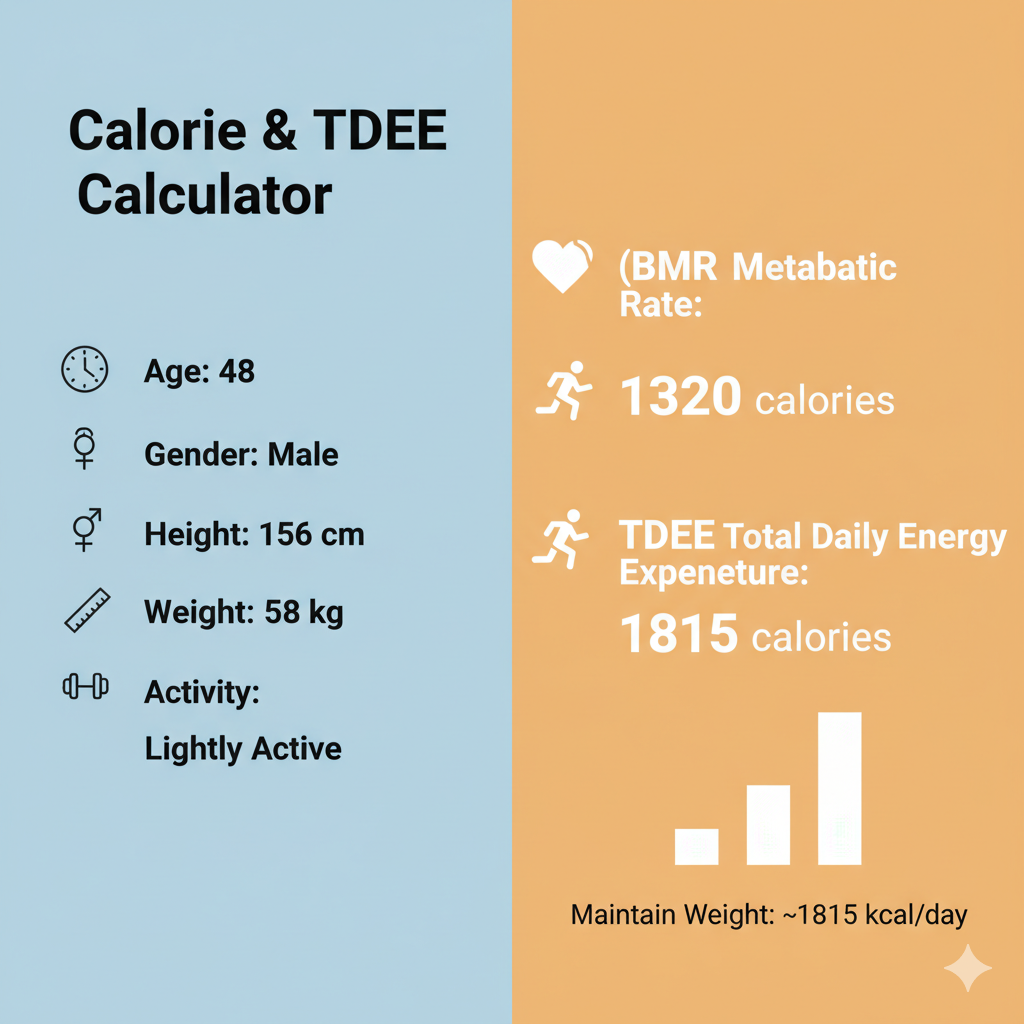
The Basal Metabolic Rate (BMR) Calculator estimates your basal metabolic rate—the amount of energy expended while at rest in a neutrally temperate environment, and in a post-absorptive state (meaning that the digestive system is inactive, which requires about 12 hours of fasting).
Modify the values and click the calculate button to use
US Units Metric Units Other Units
Age
25
ages 15 – 80
Gender
Height
5
feet
10
inches
Weight
160
pounds
+ Settings
ResultSave this calculation
BMR = 1,717 Calories/day
Daily calorie needs based on activity level
Activity Level Calorie
Sedentary: little or no exercise 2,060
Exercise 1-3 times/week 2,361
Exercise 4-5 times/week 2,515
Daily exercise or intense exercise 3-4 times/week 2,661
Intense exercise 6-7 times/week 2,962
Very intense exercise daily, or physical job 3,262
Exercise: 15-30 minutes of elevated heart rate activity.
Intense exercise: 45-120 minutes of elevated heart rate activity.
Very intense exercise: 2+ hours of elevated heart rate activity.
Related
Body Fat Calculator | Calorie Calculator
The basal metabolic rate (BMR) is the amount of energy needed while resting in a temperate environment when the digestive system is inactive. It is the equivalent of figuring out how much gas an idle car consumes while parked. In such a state, energy will be used only to maintain vital organs, which include the heart, brain, kidneys, nervous system, intestines, liver, lungs, sex organs, muscles, and skin. For most people, upwards of ~70% of total energy (calories) burned each day is due to upkeep. Physical activity makes up ~20% of expenditure and ~10% is used for the digestion of food, also known as thermogenesis.
The BMR is measured under very restrictive circumstances while awake. An accurate BMR measurement requires that a person’s sympathetic nervous system is inactive, which means the person must be completely rested. Basal metabolism is usually the largest component of a person’s total caloric needs. The daily caloric need is the BMR value multiplied by a factor with a value between 1.2 and 1.9, depending on activity level.
In most situations, the BMR is estimated with equations summarized from statistical data. The Harris-Benedict Equation was one of the earliest equations introduced. It was revised in 1984 to be more accurate and was used up until 1990, when the Mifflin-St Jeor Equation was introduced. The Mifflin-St Jeor Equation has been shown to be more accurate than the revised Harris-Benedict Equation. The Katch-McArdle Formula is slightly different in that it calculates resting daily energy expenditure (RDEE), which takes lean body mass into account, something that neither the Mifflin-St Jeor nor the Harris-Benedict Equation does. Of these equations, the Mifflin-St Jeor Equation is considered the most accurate equation for calculating BMR with the exception that the Katch-McArdle Formula can be more accurate for people who are leaner and know their body fat percentage. You can pick the equation to be used in the calculation by expanding the settings.
The three equations used by the calculator are listed below:
Mifflin-St Jeor Equation:
For men:
BMR = 10W + 6.25H – 5A + 5
For women:
BMR = 10W + 6.25H – 5A – 161
Revised Harris-Benedict Equation:
For men:
BMR = 13.397W + 4.799H – 5.677A + 88.362
For women:
BMR = 9.247W + 3.098H – 4.330A + 447.593
Katch-McArdle Formula:
BMR = 370 + 21.6(1 – F)W
where:
W is body weight in kg
H is body height in cm
A is age
F is body fat in percentage
BMR Variables
Muscle Mass – Aerobic exercises, such as running or cycling, have no effect on BMR. However, anaerobic exercises, such as weight-lifting, indirectly lead to a higher BMR because they build muscle mass, increasing resting energy consumption. The more muscle mass in the physical composition of an individual, the higher the BMR required to sustain their body at a certain level.
Age – The more elderly and limber an individual, the lower their BMR, or the lower the minimum caloric intake required to sustain the functioning of their organs at a certain level.
Genetics – Hereditary traits passed down from ancestors influence BMR.
Weather – Cold environments raise BMR because of the energy required to create a homeostatic body temperature. Likewise, too much external heat can raise BMR as the body expends energy to cool off internal organs. BMR increases approximately 7% for every increase of 1.36 degrees Fahrenheit in the body’s internal temperature.
Diet – Small, routinely dispersed meals increase BMR. On the other hand, starvation can reduce BMR by as much as 30%. Similar to a phone that goes into power-saving mode during the last 5% of its battery, a human body will make sacrifices such as energy levels, moods, upkeep of bodily physique, and brain functions in order to more efficiently utilize what little caloric energy is being used to sustain it.
Pregnancy – Ensuring the livelihood of a separate fetus internally increases BMR. This is why pregnant women tend to eat more than usual. Also, menopause can increase or decrease BMR depending on hormonal changes.
Supplements – Certain supplements or drugs raise BMR, mostly to fuel weight loss. Caffeine is a common one.
BMR Tests
Online BMR tests with rigid formulas are not the most accurate method of determining an individual’s BMR. It is better to consult a certified specialist or measure BMR through a calorimetry device. These handheld devices are available in many health and fitness clubs, doctor offices, and weight-loss clinics.
Resting Metabolic Rate
While the two are used interchangeably, there is a key difference in their definitions. Resting metabolic rate, or RMR for short, is the rate at which the body burns energy in a relaxed, but not fully inactive state. It is also sometimes defined as resting energy expenditure, or REE. BMR measurements must meet total physiological equilibrium while RMR conditions of measurement can be altered and defined by contextual limitations.
Modern Wisdom
A 2005 meta-analysis study on BMR* showed that when controlling all factors of metabolic rate, there is still a 26% unknown variance between people. Essentially, an average person eating an average diet will likely have expected BMR values, but there are factors that are still not understood that determines BMR precisely.
Therefore, all BMR calculations, even using the most precise methods through specialists, will not be perfectly accurate in their measurements. Not all human bodily functions are well understood just yet, so calculating total daily energy expenditure (TDEE) derived from BMR estimates are just that, estimates. When working towards any sort of health or fitness goal, BMR can aid in laying down the foundations, but from there on, it has little else to offer. A calculated BMR and thus TDEE may result in unsatisfactory results because of their rough estimates, but maintaining a daily journal of exercise, food consumption, etc., can help track the factors that lead to any given results and help determine what works, as well as what needs to be improved upon. Tracking progress in said journal and making adjustments over time as needed is generally the best indication of progress towards reaching personal goals.
Reference
* Johnstone AM, Murison SD, Duncan JS, Rance KA, Speakman JR, Factors influencing variation in basal metabolic rate include fat-free mass, fat mass, age, and circulating thyroxine but not sex, circulating leptin, or triiodothyronine1. Am J Clin Nutr 2005; 82: 941-948.
Summary of Your Input and Result
Age: 25
Gender: Male (inferred from the BMR equation used and the result)
Height: 5 feet 10 inches
Weight: 160 pounds
BMR Result: 1,717 Calories per day
This means your body requires approximately 1,717 calories each day at complete rest to maintain basic physiological functions like breathing, circulation, and cell production.
Daily Calorie Needs Based on Activity Level
This table expands on the calculation provided, showing how your BMR is used to estimate your Total Daily Energy Expenditure (TDEE). TDEE is the total number of calories you burn in a day, including all activity.
Activity Level Description Calculation (BMR x Activity Factor) Estimated Calorie Need
Sedentary Little or no exercise 1717 x 1.2 2,060 calories/day
Lightly Active Exercise 1-3 times/week 1717 x 1.375 2,361 calories/day
Moderately Active Exercise 4-5 times/week 1717 x 1.465 2,515 calories/day
Very Active Daily exercise or intense exercise 3-4 times/week 1717 x 1.55 2,661 calories/day
Extremely Active Intense exercise 6-7 times/week 1717 x 1.725 2,962 calories/day
Professional Athlete Very intense exercise daily, or physical job 1717 x 1.9 3,262 calories/day
Detailed Analysis and Context
1. Which Equation Was Used?
The calculator most likely used the Mifflin-St Jeor Equation, which is considered the most accurate for the general population. Let’s verify this with your metrics.
Weight (W): 160 lbs ÷ 2.205 = 72.6 kg
Height (H): (5 ft × 12) + 10 in = 70 in; 70 in × 2.54 = 177.8 cm
Age (A): 25 years
Mifflin-St Jeor for Men:
BMR = (10 × 72.6 kg) + (6.25 × 177.8 cm) – (5 × 25) + 5
BMR = 726 + 1111.25 – 125 + 5
BMR = 1,717 calories/day 
This confirms the calculator used the Mifflin-St Jeor Equation.
2. What Do These Numbers Mean For You?
For Weight Maintenance: To maintain your current weight of 160 lbs, you should consume the number of calories corresponding to your true activity level.
For Weight Loss: A common and sustainable approach is to create a calorie deficit of 500 calories per day from your TDEE. This would lead to about one pound of fat loss per week.
Example: If you are “Moderately Active,” your target for weight loss would be approximately 2,015 calories/day (2,515 – 500).
For Weight Gain: To gain weight, primarily muscle mass, you would need to consume 300-500 calories above your TDEE, combined with strength training.
3. Important Factors and Limitations (The “Fine Print”)
As the article you provided mentions, BMR calculations are estimates. Several factors specific to you can make the actual number higher or lower:
Muscle Mass: The Katch-McArdle formula (which uses body fat percentage) might be more accurate if you are athletic. Since you know your BMR but not your body fat, we can work backwards to estimate your Lean Body Mass:
Katch-McArdle: BMR = 370 + (21.6 × Lean Body Mass in kg)
1717 = 370 + (21.6 × LBM)
LBM ≈ 62.3 kg (137 lbs)
This suggests a body fat percentage of approximately 14.5%, which is in the “Fitness” range for a male. If you have more or less muscle than this, your actual BMR could differ.
Genetics, Diet, and Other Factors: As noted, genetics, weather, meal timing, and supplements can all influence your true metabolic rate. The 26% unknown variance mentioned in the “Modern Wisdom” section is critical to remember.
Recommendation
Use your calculated BMR of 1,717 and the corresponding TDEE estimates as a starting point.
Choose the activity level that best matches your lifestyle.
Track your food intake and weight consistently for 2-3 weeks.
Adjust based on results:
If your weight is stable, you’ve found your true maintenance calories.
If you’re gaining or losing weight unexpectedly, adjust your calorie intake by 100-200 calories and reassess.
This hands-on tracking and adjusting will always be more accurate than any static online calculation.
Calorie Calculator
The Calorie Calculator can be used to estimate the number of calories a person needs to consume each day. This calculator can also provide some simple guidelines for gaining or losing weight.
Modify the values and click the calculate button to use
US Units Metric Units Other Units
Age
25
ages 15 – 80
Gender
Height
5
feet
10
inches
Weight
165
pounds
Activity
Moderate: exercise 4-5 times/week
+ Settings
Exercise: 15-30 minutes of elevated heart rate activity.
Intense exercise: 45-120 minutes of elevated heart rate activity.
Very intense exercise: 2+ hours of elevated heart rate activity.
Food Energy Converter
The following converter can be used to convert between Calories and other common food energy units.
1
Calorie [Nutritional, kcal]
= 4.1868
Kilojoules [kJ]
Related:
BMI Calculator | Body Fat Calculator | Ideal Weight Calculator
This Calorie Calculator is based on several equations, and the results of the calculator are based on an estimated average. The Harris-Benedict Equation was one of the earliest equations used to calculate basal metabolic rate (BMR), which is the amount of energy expended per day at rest. It was revised in 1984 to be more accurate and was used up until 1990, when the Mifflin-St Jeor Equation was introduced. The Mifflin-St Jeor Equation also calculates BMR, and has been shown to be more accurate than the revised Harris-Benedict Equation. The Katch-McArdle Formula is slightly different in that it calculates resting daily energy expenditure (RDEE), which takes lean body mass into account, something that neither the Mifflin-St Jeor nor the Harris-Benedict Equation do. Of these equations, the Mifflin-St Jeor Equation is considered the most accurate equation for calculating BMR with the exception that the Katch-McArdle Formula can be more accurate for people who are leaner and know their body fat percentage. The three equations used by the calculator are listed below:
Mifflin-St Jeor Equation:
For men:
BMR = 10W + 6.25H – 5A + 5
For women:
BMR = 10W + 6.25H – 5A – 161
Revised Harris-Benedict Equation:
For men:
BMR = 13.397W + 4.799H – 5.677A + 88.362
For women:
BMR = 9.247W + 3.098H – 4.330A + 447.593
Katch-McArdle Formula:
BMR = 370 + 21.6(1 – F)W
where:
W is body weight in kg
H is body height in cm
A is age
F is body fat in percentage
The value obtained from these equations is the estimated number of calories a person can consume in a day to maintain their body-weight, assuming they remain at rest. This value is multiplied by an activity factor (generally 1.2-1.95) dependent on a person’s typical levels of exercise, which accounts for times during the day when a person is not at rest. 1 pound, or approximately 0.45 kg, equates to about 3,500 calories. As such, in order to lose 1 pound per week, it is recommended that 500 calories be shaved off the estimate of calories necessary for weight maintenance per day. For example, if a person has an estimated allotment of 2,500 calories per day to maintain body-weight, consuming 2,000 calories per day for one week would theoretically result in 3,500 calories (or 1 pound) lost during the period.
It is important to remember that proper diet and exercise is largely accepted as the best way to lose weight. It is inadvisable to lower calorie intake by more than 1,000 calories per day, as losing more than 2 pounds per week can be unhealthy, and can result in the opposite effect in the near future by reducing metabolism. Losing more than 2 pounds a week will likely involve muscle loss, which in turn lowers BMR, since more muscle mass results in higher BMR. Excessive weight loss can also be due to dehydration, which is unhealthy. Furthermore, particularly when exercising in conjunction with dieting, maintaining a good diet is important, since the body needs to be able to support its metabolic processes and replenish itself. Depriving the body of the nutrients it requires as part of heavily unhealthy diets can have serious detrimental effects, and weight lost in this manner has been shown in some studies to be unsustainable, since the weight is often regained in the form of fat (putting the participant in a worse state than when beginning the diet). As such, in addition to monitoring calorie intake, it is important to maintain levels of fiber intake as well as other nutritional necessities to balance the needs of the body.
Calorie Counting as a Means for Weight Loss
Calorie counting with the intent of losing weight, on its simplest levels, can be broken down into a few general steps:
Determine your BMR using one of the provided equations. If you know your body fat percentage, the Katch-McArdle Formula might be a more accurate representation of your BMR. Remember that the values attained from these equations are approximations and subtracting exactly 500 calories from your BMR will not necessarily result in exactly 1 pound lost per week – it could be less, or it could be more!
Determine your weight loss goals. Recall that 1 pound (~0.45 kg) equates to approximately 3500 calories, and reducing daily caloric intake relative to estimated BMR by 500 calories per day will theoretically result in a loss of 1 pound a week. It is generally not advisable to lose more than 2 pounds per week as it can have negative health effects, i.e. try to target a maximum daily calorie reduction of approximately 1000 calories per day. Consulting your doctor and/or a registered dietician nutritionist (RDN) is recommended in cases where you plan to lose more than 2 pounds per week.
Choose a method to track your calories and progress towards your goals. If you have a smartphone, there are many easy-to-use applications that facilitate tracking calories, exercise, and progress, among other things. Many, if not all of these, have estimates for the calories in many brand-name foods or dishes at restaurants, and if not, they can estimate calories based on the amount of the individual components of the foods. It can be difficult to get a good grasp on food proportions and the calories they contain – which is why counting calories (as well as any other approach) is not for everyone – but if you meticulously measure and track the number of calories in some of your typical meals, it quickly becomes easier to accurately estimate calorie content without having to actually measure or weigh your food each time. There are also websites that can help to do the same, but if you prefer, manually maintaining an excel spreadsheet or even a pen and paper journal are certainly viable alternatives.
Track your progress over time and make changes to better achieve your goals if necessary. Remember that weight loss alone is not the sole determinant of health and fitness, and you should take other factors such as fat vs. muscle loss/gain into account as well. Also, it is recommended that measurements are taken over longer periods of time such as a week (rather than daily) as significant variations in weight can occur simply based on water intake or time of day. It is also ideal to take measurements under consistent conditions, such as weighing yourself as soon as you wake up and before breakfast, rather than at different times throughout the day.
Keep at it!
The above steps are an attempt at the most basic form of calorie counting. Calorie counting is not an exact science, and can be as complex as you want to make it. The above does not consider the proportions of macronutrients consumed. While there is no exactly known, ideal proportion of macronutrients (fats, proteins, carbohydrates), some balance is certainly advisable, and different foods have been found to have different effects on health, feelings of hunger, and number of calories burned. Generally, minimally processed plant and animal foods tend to be more conducive to healthy weight loss and maintenance.
There are many approaches to weight loss and there is no set ideal method that works for all people, which is why so many different diets and exercise regimens exist. While some methods are more effective for each individual person, not all weight loss methods are equivalent, and studies suggest that some approaches are healthier than others. That being said, one of the most commonly effective weight loss methods is counting calories. In its most basic form, calories consumed minus calories expended will result in weight gain if the result is positive, or weight loss if the result is negative. However, this is far from a comprehensive picture, and many other factors play a role in affecting healthy, sustainable weight loss. For example, there exist conflicting studies addressing whether or not the type of calories or foods consumed, or how they are consumed, affects weight loss. Studies have shown that foods that require a person to chew more and are more difficult to digest result in the body burning more calories, sometimes referred to as the thermic effect of food. While the increase in burned calories may be marginal, foods that are more difficult to digest such as vegetables generally tend to be healthier and provide more nutrients for fewer calories than many processed foods.
Consistent with the view that in regards to weight loss, only net calories are important and not their source, there exist cases such as the Twinkie diet, where a person that solely counted calories while eating a variety of cake snacks managed to lose 27 pounds over two months. As effective as this can be, it is certainly not suggested. While the participant did not seem to suffer any noticeable health detriments in this particular case, there are other less measurable factors that should be considered such as long-term effects of such a diet on potential for developing cancers, heart disease, and diabetes. However, ignoring efficiency and health, sustained, significant reduction of caloric intake or increase of physical activity should result in weight loss, and counting calories can be an effective way to achieve this sole result.
Aside from being one viable method for facilitating weight loss, calorie counting has other somewhat less quantifiable advantages including helping to increase nutritional awareness. Many people are completely unaware of, or grossly underestimate their daily caloric intake. Counting calories can help raise awareness of different types of foods, the number of calories they contain, and how these calories have a different effect on a person’s feelings of satiety. Once a person has a better understanding of how many calories are actually in that bag of chips that they can so easily inhale within minutes, how much of their daily caloric intake it consumes, and how little the chips do to satiate their hunger, portion control and avoidance of foods with empty calories tends to become easier.
Having actual caloric measurements can also assist in weight loss, since tangible calorie goals can be set, rather than simply trying to eat less. Also, although this is not necessarily directly related to calorie counting, studies have shown that portion control by simply eating from a smaller plate can help reduce calorie intake, since people tend to fill their plates and eat everything on their plates. Many people do not realize that they are overeating, since they have become accustomed to restaurant-sized portions being the norm, when said portions can be up to three or more times larger than necessary for a typical meal.
Tracking calories also puts exercise in a quantifiable perspective, increasing a person’s awareness regarding how much exercise is really required to counteract a 220-calorie bag of M&M’s. Once a link is made between the amount of exercise that some snack equates to, many people find abstaining from that bag of chips to be the preferred option rather than performing an equivalent amount of exercise – which can lead to healthier eating habits.
In the end, however, what’s important is picking a strategy that works for you. Calorie counting is only one method used to achieve weight loss amongst many, and even within this method, there are many possible approaches a person can take. Finding an approach that fits within your lifestyle that you think you would be able to adhere to is likely going to provide the most sustainable option and desirable result.
Zigzag Calorie Cycling
Zigzag calorie cycling is a weight loss approach that aims to counteract the human body’s natural adaptive tendencies. Counting and restricting calories, as described above, is a viable method to lose weight, but over a period of time, it is possible for the body to adapt to the lower number of calories consumed. In cases where this happens, a plateau in weight loss that can be difficult to surmount can result. This is where zigzag calorie cycling can help, by not allowing the body to adapt to the lower calorie environment.
Zigzag calorie cycling involves alternating the number of calories consumed on a given day. A person on a zigzag diet should have a combination of high-calorie and low-calorie days to meet the same overall weekly calorie target. For example, if your target calorie intake is 14,000 calories per week, you could consume 2,300 calories three days a week, and 1,775 the other four days of the week, or you could consume 2,000 calories each day. In both cases, 14,000 calories would be consumed over the week, but the body wouldn’t adapt and compensate for a 2,000-calorie diet. This also allows a person more flexibility in their diet, allowing them to plan around occasions, such as work or family gatherings, where a person may consume more calories. Consuming a lower number of calories on other days can allow a person to enjoy these gatherings or even have a “cheat day” where they eat whatever they want without feeling guilty, since they can make up for the excess calories on their low-calorie days.
There is no concrete rule or study that dictates the most effective way to alternate or spread out calorie consumption. How to vary calorie intake is largely up to personal discretion. Depending on a person’s activity, it is generally recommended that the high-calorie and low-calorie days vary by approximately 200-300 calories, where the high-calorie day is often the number of calories a person needs to consume to maintain their current weight. For a person with a higher activity level, the calorie difference should be larger. The calculator presents two zigzag diet schedules. The first schedule has two higher calorie days and five lower calorie days. The second schedule increases and reduces calories gradually. In either case, the total weekly calorie consumption is the same.
In the end, regardless of what method you choose to use when approaching weight loss, what’s important is picking a strategy that works for you. Calorie counting and zigzag calorie cycling are only two methods (that are fairly interrelated) used to achieve weight loss among many, and even within these methods, there are many possible approaches a person can take. Finding an approach that fits within your lifestyle that you think you would be able to adhere to is likely going to provide the most sustainable and desirable result.
How Many Calories Do You Need?
Many people seek to lose weight, and often the easiest way to do this is to consume fewer calories each day. But how many calories does the body actually need in order to be healthy? This largely depends on the amount of physical activity a person performs each day, and regardless of this, is different for all people – there are many different factors involved, not all of which are well-understood or known.
Some factors that influence the number of calories a person needs to remain healthy include age, weight, height, sex, levels of physical activity, and overall general health. For example, a physically active 25-year-old male that is 6 feet in height requires considerably higher calorie intake than a 5-foot-tall, sedentary 70-year-old woman. Though it differs depending on age and activity level, adult males generally require 2,000-3000 calories per day to maintain weight while adult females need around 1,600-2,400 according to the U.S Department of Health.
The body does not require many calories to simply survive. However, consuming too few calories results in the body functioning poorly, since it will only use calories for functions essential to survival, and ignore those necessary for general health and well-being. Harvard Health Publications suggests women get at least 1,200 calories and men get at least 1,500 calories a day unless supervised by doctors. As such, it is highly recommended that a person attempting to lose weight monitors their body’s caloric necessities and adjusts them as necessary to maintain its nutritional needs.
Calories: Different Kinds and Their Effects
The main sources of calories in a typical person’s diet are carbohydrates, proteins, and fat, with alcohol also being a significant portion of calorie intake for many people (though ideally this should be limited since alcohol contains many empty calories). Some studies have shown that the calories displayed on nutrition labels and the calories actually consumed and retained can vary significantly. This hints at the complex nature of calories and nutrition and is why many conflicting points of view on the “best” methodology for losing weight exist. For example, how a person chews their food has been shown to affect weight loss to some degree; generally speaking, chewing food more increases the number of calories that the body burns during digestion. People that chew more also tend to eat less, since the longer period of time necessary to chew their food allows more time to reach a state of satiety, which results in eating less. However, the effects of how food is chewed and digestion of different foods are not completely understood and it is possible that other factors exist, and thus this information should be taken with a grain of salt (in moderation if weight loss is the goal).
Generally, foods that take more effort to chew – fruit, vegetables, lean meats, whole grains, etc. – require the body to burn more calories since more calories are required to digest them. It also results in the feeling of satiety for longer periods of time. Furthermore, certain foods like coffee, tea, chilies, cinnamon, and ginger have been found to increase the rate of calories burned, due to the ingredients they contain.
The “quality” of calories consumed is also important. There are different classifications of foods in terms of calories. This includes high-calorie foods, low-calorie foods, and empty calories. Consistent with their naming, high-calorie foods are foods that are calorically dense, meaning that there are a high number of calories relative to serving size, while low-calorie foods have fewer calories relative to serving size. Foods such as fat, oils, fried foods, and sugary foods are examples of high-calorie foods. Being a high-calorie food does not inherently mean that the food is unhealthy however – avocados, quinoa, nuts, and whole grains are all high-calorie foods that are considered healthful in moderation. Low-calorie foods include vegetables and certain fruits, among other things, while empty calories, such as those in added sugars and solid fats, are calories that contain few to no nutrients. Studies have shown that there is a measurable difference between consuming 500 calories of carrots compared to 500 calories of popcorn. As previously mentioned, this in part can be attributed to differences in how the foods are consumed and processed. Carrots require far more chewing and can result in more calories burned during digestion. Again, the mechanism for these differences is not fully defined, but simply note that for weight loss purposes, the general formula of calories in minus calories out determining weight gain or loss does hold, but that the number of calories on a nutrition label is not necessarily indicative of how many calories the body actually retains. While there is no clear-cut or ideal amount of macronutrient proportions a person should consume to maintain a healthy diet or lose weight, eating a “healthy” diet replete with a variety of unprocessed foods such as vegetables, fruits, and lean meats is correlated with being healthier, and is more likely to result in sustainable weight loss. Also, remember that calories from drinks comprise an estimated 21% of a typical person’s diet. Many of these calories fall under the category of empty calories. While sodas are an obvious culprit, drinks such as juices and even milk have large amounts of sugar and should be consumed in moderation to avoid negating their nutritional benefits. Ideally, a person should drink water, tea, and coffee without adding sugar in order to reduce calories gained from drinks.
Remember: All foods, including “healthful foods,” should be consumed in moderation, and distinctions can often be misleading since even natural foods like fruits can have large amounts of sugar, and foods labeled as “health foods” such as low-calorie foods, reduced-fat foods, etc. can potentially replace one unhealthy component with another. Many reduced-fat foods have large amounts of added sugar to compensate for taste lost through fat reduction. It is important to pay attention to, and consider the different components in a food product in order to determine whether said food should have a place within your diet.
Calories in Common Foods
Food Serving Size Calories kJ
Fruit
Apple 1 (4 oz.) 59 247
Banana 1 (6 oz.) 151 632
Grapes 1 cup 100 419
Orange 1 (4 oz.) 53 222
Pear 1 (5 oz.) 82 343
Peach 1 (6 oz.) 67 281
Pineapple 1 cup 82 343
Strawberry 1 cup 53 222
Watermelon 1 cup 50 209
Vegetables
Asparagus 1 cup 27 113
Broccoli 1 cup 45 188
Carrots 1 cup 50 209
Cucumber 4 oz. 17 71
Eggplant 1 cup 35 147
Lettuce 1 cup 5 21
Tomato 1 cup 22 92
Proteins
Beef, regular, cooked 2 oz. 142 595
Chicken, cooked 2 oz. 136 569
Tofu 4 oz. 86 360
Egg 1 large 78 327
Fish, Catfish, cooked 2 oz. 136 569
Pork, cooked 2 oz. 137 574
Shrimp, cooked 2 oz. 56 234
Common Meals/Snacks
Bread, white 1 slice (1 oz.) 75 314
Butter 1 tablespoon 102 427
Caesar salad 3 cups 481 2014
Cheeseburger 1 sandwich 285 1193
Hamburger 1 sandwich 250 1047
Dark Chocolate 1 oz. 155 649
Corn 1 cup 132 553
Pizza 1 slice (14″) 285 1193
Potato 6 oz. 130 544
Rice 1 cup cooked 206 862
Sandwich 1 (6″ Subway Turkey Sandwich) 200 837
Beverages/Dairy
Beer 1 can 154 645
Coca-Cola Classic 1 can 150 628
Diet Coke 1 can 0 0
Milk (1%) 1 cup 102 427
Milk (2%) 1 cup 122 511
Milk (Whole) 1 cup 146 611
Orange Juice 1 cup 111 465
Apple cider 1 cup 117 490
Yogurt (low-fat) 1 cup 154 645
Yogurt (non-fat) 1 cup 110 461
* 1 cup = ~250 milliliters, 1 table spoon = 14.2 gram
2000, 1500, and 1200 Calorie Sample Meal Plans
Meal 1200 Cal Plan 1500 Cal Plan 2000 Cal Plan
Breakfast All-bran cereal (125)
Milk (50)
Banana (90)
Granola (120)
Greek yogurt (120)
Blueberries (40)
Buttered toast (150)
Egg (80)
Banana (90)
Almonds (170)
Snack Cucumber (30)
Avocado dip (50)
Orange (70)
Greek yogurt (120)
Blueberries (40)
Total 345 Calories 350 Calories 650 Calories
Lunch Grilled cheese with tomato (300)
Salad (50)
Chicken and vegetable soup (300)
Bread (100)
Grilled chicken (225)
Grilled vegetables (125)
Pasta (185)
Snack Walnuts (100)
Apple (75)
Peanut butter (75)
Hummus (50)
Baby carrots (35)
Crackers (65)
Total 450 Calories 550 Calories 685 Calories
Dinner Grilled Chicken (200)
Brussel sprouts (100)
Quinoa (105)
Steak (375)
Mashed potatoes (150)
Asparagus (75)
Grilled salmon (225)
Brown rice (175)
Green beans (100)
Walnuts (165)
Total 405 Calories 600 Calories 665 Calories
Calories Burned from Common Exercises:
Activity (1 hour) 125 lb person 155 lb person 185 lb person
Golf (using cart) 198 246 294
Walking (3.5 mph) 215 267 319
Kayaking 283 352 420
Softball/Baseball 289 359 428
Swimming (free-style, moderate) 397 492 587
Tennis (general) 397 492 587
Running (9 minute mile) 624 773 923
Bicycling (12-14 mph, moderate) 454 562 671
Football (general) 399 494 588
Basketball (general) 340 422 503
Soccer (general) 397 492 587
Energy from Common Food Components
Food Components kJ per gram Calorie (kcal) per gram kJ per ounce Calorie (kcal) per ounce
Fat 37 8.8 1,049 249
Proteins 17 4.1 482 116
Carbohydrates 17 4.1 482 116
Fiber 8 1.9 227 54
Ethanol (drinking alcohol) 29 6.9 822 196
Organic acids 13 3.1 369 88
Polyols (sugar alcohols, sweeteners) 10 2.4 283 68
Summary of Your Input and Result
Age: 25
Gender: Male (inferred from the equations and result)
Height: 5 feet 10 inches
Weight: 165 pounds
Activity Level: Moderate (exercise 4-5 times/week)
Estimated Calorie Need: The calculator’s primary result would be the maintenance calories for this activity level. Based on standard formulas, this is approximately 2,580 calories/day.
This means that to maintain your current weight of 165 lbs with your stated activity level, you should consume about 2,580 calories per day.
Detailed Analysis & Calorie Goals
This table shows your estimated calorie expenditure for all activity levels, with your specific “Moderate” level highlighted.
Activity Level Description Activity Factor Estimated Calorie Need (Maintenance)
Sedentary Little or no exercise 1.2 ~2,150 calories/day
Lightly Active Exercise 1-3 times/week 1.375 ~2,465 calories/day
Moderately Active Exercise 4-5 times/week 1.55 ~2,580 calories/day
Very Active Daily exercise or intense exercise 3-4 times/week 1.725 ~2,870 calories/day
Extremely Active Intense exercise 6-7 times/week 1.9 ~3,155 calories/day
Calorie Goals for Weight Change
Using your maintenance calories of ~2,580 as a baseline, here are your targets for different goals:
Weight Maintenance: Consume approximately 2,580 calories per day.
Mild Weight Loss (0.5 lb/week): Consume approximately 2,330 calories per day. (A 250-calorie deficit)
Weight Loss (1 lb/week): Consume approximately 2,080 calories per day. (A 500-calorie deficit)
Weight Gain (0.5 lb/week): Consume approximately 2,830 calories per day. (A 250-calorie surplus)
Important Warning: The calculator correctly advises that you should not reduce your daily intake by more than 1,000 calories, as losing more than 2 pounds per week can be unhealthy and counterproductive.
The Math Behind the Result
The calculator first estimates your Basal Metabolic Rate (BMR) using the Mifflin-St Jeor Equation (the most accurate for the general population), then multiplies it by an activity factor.
Calculate BMR:
Weight (W): 165 lbs / 2.205 = 74.8 kg
Height (H): (5 ft × 12) + 10 in = 70 in; 70 in × 2.54 = 177.8 cm
Age (A): 25 years
Mifflin-St Jeor for Men:
BMR = (10 × 74.8 kg) + (6.25 × 177.8 cm) – (5 × 25) + 5
BMR = 748 + 1111.25 – 125 + 5
BMR = 1,739 calories/day
Calculate Total Daily Energy Expenditure (TDEE):
Activity Factor for “Moderate”: 1.55
TDEE = BMR × Activity Factor
TDEE = 1,739 × 1.55 = 2,695 calories/day
The calculator may use a slightly more precise activity factor or a different rounding method, which is why its result (~2,580) is a close but not exact match to this manual calculation. Both numbers are valid estimates.
Key Takeaways and Practical Advice
The provided text offers excellent context for using this number effectively. Here are the most important points for you:
It’s an Estimate: Your calculated maintenance of ~2,580 calories is a starting point. You must adjust based on real-world results. If you are not losing/gaining weight as expected after 2-3 weeks, adjust your intake by 100-200 calories.
Calorie Quality Matters: While a “calorie is a calorie” for pure weight change, the source of the calorie affects your health, hunger, and energy. The calculator emphasizes eating whole, minimally processed foods (vegetables, lean meats, whole grains) over empty calories from sugary drinks and processed snacks.
Consider Zigzag Calorie Cycling: If you hit a weight loss plateau, the “zigzag” method can help. For example, you could alternate between 2,200 calories on low-activity days and 2,800 calories on high-activity or social days, maintaining the same weekly average.
Use the Tools Provided: The calculator includes extensive resources like:
Calorie Chart: Use this to get a sense of the energy content in common foods.
Sample Meal Plans: The 2,000 and 1,500 calorie plans are excellent templates for structuring your meals.
Exercise Calorie Burn Chart: This helps put food intake into perspective (e.g., you’d need to run for ~30 minutes to burn off a bag of M&Ms).
Recommendation
Start: Begin by consuming ~2,080 calories per day for weight loss (or ~2,580 for maintenance).
Track: Use a smartphone app or journal to log your food intake and weight consistently.
Adjust: After two weeks, check your progress. If your weight hasn’t moved as desired, adjust your calorie target slightly.
Focus on Nutrition: Build your diet around the high-quality foods listed in the calculator’s tables to ensure you’re meeting your nutritional needs while you manage your weight.
Body Fat Calculator
The Body Fat Calculator can be used to estimate your total body fat based on specific measurements. Use the “Metric Units” tab if you are more comfortable with the International System of Units (SI). To get the best results, measure to the nearest 1/4 inch (0.5 cm). This calculation is based on the U.S. Navy method, but also includes the calculation of body fat percentage using the BMI method (both of which are outlined below).
Body Fat (U.S. Navy Method) 15.3%
Body Fat Category Fitness
Body Fat Mass 23.2 lbs
Lean Body Mass 128.8 lbs
Ideal Body Fat for Given Age
(Jackson & Pollock) 10.5%
Body Fat to Lose to Reach Ideal 7.2 lbs
Body Fat (BMI method) 15.4%
Related
BMI Calculator | Calorie Calculator | Ideal Weight Calculator
Reference
The American Council on Exercise Body Fat Categorization
Description Women Men
Essential fat 10-13% 2-5%
Athletes 14-20% 6-13%
Fitness 21-24% 14-17%
Average 25-31% 18-24%
Obese 32+% 25+%
Jackson & Pollock Ideal Body Fat Percentages
Age Women Men
20 17.7% 8.5%
25 18.4% 10.5%
30 19.3% 12.7%
35 21.5% 13.7%
40 22.2% 15.3%
45 22.9% 16.4%
50 25.2% 18.9%
55 26.3% 20.9%
Body Fat, Overweight, and Obesity
The scientific term for body fat is “adipose tissue.” Adipose tissue serves a number of important functions. Its primary purpose is to store lipids from which the body creates energy. In addition, it secretes a number of important hormones, and provides the body with some cushioning as well as insulation.
Body fat includes essential body fat and storage body fat. Essential body fat is a base level of fat that is found in most parts of the body. It is necessary fat that maintains life and reproductive functions. The amount of essential fat differs between men and women, and is typically around 2-5% in men, and 10-13% in women. The healthy range of body fat for men is typically defined as 8-19%, while the healthy range for women is 21-33%. While having excess body fat can have many detrimental effects on a person’s health, insufficient body fat can have negative health effects of its own, and maintaining a body fat percentage below, or even at the essential body fat percentage range is a topic that should be discussed with a medical professional.
Storage fat is fat that accumulates in adipose tissue, be it subcutaneous fat (deep under the dermis and wrapped around vital organs) or visceral fat (fat located inside the abdominal cavity, between organs), and references to body fat typically refer to this type of fat. While some storage fat is ideal, excess amounts of storage fat can have serious negative health implications.
Excess body fat leads to the condition of being overweight and eventually to obesity given that insufficient measures are taken to curb increasing body fat. Note that being overweight does not necessarily indicate an excess of body fat. A person’s body weight is comprised of multiple factors including (but not limited to) body fat, muscle, bone density, and water content. Thus, highly muscular people are often classified as overweight.
The rate at which body fat accumulates is different from person to person and is dependent on many factors including genetic factors as well as behavioral factors such as lack of exercise and excessive food intake. Due to varying factors, it can be more difficult for certain people to reduce body fat stored in the abdominal region. However, managing diet and exercise has been shown to reduce stored fat. Note that both women and men store body fat differently and that this can change over time. After the age of 40 (or after menopause in some cases for women), reduced sexual hormones can lead to excess body fat around the stomach in men, or around the buttocks and thighs of women.
Potential Complications of Excess Body Fat
The World Health Organization (WHO) classifies obesity as one of the leading preventable causes of death worldwide that is estimated to claim 111,909 to 365,000 deaths per year in the U.S. This has been a growing cause for concern because 36.5% of U.S. adults are defined as obese according to the Centers for Disease Control and Prevention.
Obesity is associated with a reduction in quality of life, poorer mental health outcomes, obstructive sleep apnea, as well as multiple leading causes of death worldwide such as cardiovascular disease, stroke, certain cancers and diabetes. All of these potential complications have the ability to reduce a person’s life expectancy, and as such, obesity is a medical condition that is studied by many researchers.
As previously mentioned, fat produces a number of essential hormones that affect a person’s body. An excess or a lack of critical hormones can have negative effects that preclude proper body function. On a related note, studies have found that excess body fat, particularly abdominal fat, disrupts the normal balance and function of some of these hormones. Furthermore, body fat, specifically visceral fat, has a role in the release of specific cytokines, which are a broad category of proteins involved in cell signaling, that can potentially increase the risk of cardiovascular disease. Visceral fat is also directly associated with higher levels of low-density lipoprotein (LDL) cholesterol, lower high-density lipoprotein (HDL) cholesterol, and insulin resistance. LDL cholesterol is commonly referred to as “bad cholesterol” while HDL is referred to as “good cholesterol.” High levels of LDL cholesterol can clog arteries and lead to complications including heart attacks. Insulin resistance involves cells not properly responding to the hormone insulin, which can lead to high blood sugar levels, and eventually to type 2 diabetes. As can be seen, excess visceral fat can have measurable negative impacts to a person’s health.
Measuring Body Fat Percentage
U.S. Navy Method:
There are many specific techniques used for measuring body fat. The calculator above uses a method involving equations developed at the Naval Health Research Center by Hodgdon and Beckett in 1984. The method for measuring the relevant body parts as well as the specific equations used are provided below:
Measure the circumference of the subject’s waist at a horizontal level around the navel for men, and at the level with the smallest width for women. Ensure that the subject does not pull their stomach inwards to obtain accurate measurements.
Measure the circumference of the subject’s neck starting below the larynx, with the tape sloping downward to the front. The subject should avoid flaring their neck outwards.
For women only: Measure the circumference of the subject’s hips at the largest horizontal measure.
Once these measurements are obtained, use the following formulas to calculate an estimate of body fat. Two equations are provided, one using the U.S. customary system (USC), which uses inches, and the other using the International System of Units, specifically the unit of centimeters:
Body fat percentage (BFP) formula for males:
USC Units:
BFP = 86.010×log10(abdomen-neck) – 70.041×log10(height) + 36.76
SI, Metric Units:
BFP =
495
1.0324 – 0.19077×log10(waist-neck) + 0.15456×log10(height)
– 450
Body fat percentage (BFP) formula for females:
USC Units:
BFP = 163.205×log10(waist+hip-neck) – 97.684×(log10(height)) – 78.387
SI, Metric Units:
BFP =
495
1.29579 – 0.35004×log10(waist+hip-neck) + 0.22100×log10(height)
– 450
Note that the results of these calculations are only an estimate since they are based on many different assumptions to make them as applicable to as many people as possible. For more accurate measurements of body fat, the use of instruments such as bioelectric impedance analysis or hydrostatic density testing is necessary.
Fat mass (FM) formula:
FM = BF × Weight
Lean Mass (LM) formula:
LM = Weight – FM
BMI Method:
Another method for calculating an estimate of body fat percentage uses BMI. Refer to the BMI Calculator to obtain an estimate of BMI for use with the BMI method, as well as further detail on how BMI is calculated, its implications, and its limitations. Briefly, the estimation of BMI involves the use of formulas that require the measurement of a person’s height and weight. Given BMI, the following formulas can be used to estimate a person’s body fat percentage.
Body fat percentage (BFP) formula for adult males:
BFP = 1.20 × BMI + 0.23 × Age – 16.2
Body fat percentage (BFP) formula for adult females:
BFP = 1.20 × BMI + 0.23 × Age – 5.4
Body fat percentage (BFP) formula for boys:
BFP = 1.51 × BMI – 0.70 × Age – 2.2
Body fat percentage (BFP) formula for girls:
BFP = 1.51 × BMI – 0.70 × Age + 1.4
Search
Fitness and Health Calculators
BMICalorieBody FatBMRMacroIdeal WeightPregnancyPregnancy Weight GainPregnancy ConceptionDue DatePaceMore Fitness and Health Calculators
Excellent. This Body Fat Calculator result provides a crucial piece of the puzzle, giving us a much more personalized and accurate picture of your metabolic health and caloric needs.
Here is a comprehensive analysis of your body fat results, integrated with the previous data from the BMR and Calorie Calculators.
Summary of Your Body Fat Results
Body Fat Percentage (U.S. Navy Method): 15.3%
Body Fat Category: Fitness
Fat Mass: 23.2 lbs
Lean Body Mass: 128.8 lbs
Ideal Body Fat (for age 25): 10.5%
Body Fat to Lose to Reach Ideal: 7.2 lbs
Detailed Analysis & Interpretation
1. What Your Body Fat Percentage Means
A body fat percentage of 15.3% for a 25-year-old male is considered very good and falls squarely within the “Fitness” category. This is typical for men who exercise regularly (which aligns with your “Moderate” activity level of 4-5 times/week). At this level, muscle definition (particularly in the arms and shoulders) is visible, but abdominal definition may not be sharp.
You are not “average” (18-24%): You have a healthier body composition than the typical sedentary male.
You are close to the “Athlete” range (6-13%): With a dedicated effort, reaching the higher end of the athlete range is a realistic goal.
2. The Most Accurate BMR & Calorie Analysis Yet
Your Lean Body Mass (LBM) of 128.8 lbs (58.4 kg) is the key variable. As mentioned in the earlier texts, the Katch-McArdle formula is the most accurate for people who know their body composition.
Let’s recalculate your BMR using this superior formula:
Katch-McArdle Formula: BMR = 370 + (21.6 × Lean Body Mass in kg)
BMR = 370 + (21.6 × 58.4 kg)
BMR = 370 + 1261.44
BMR = 1,631 calories/day
This is likely a more accurate BMR for you than the 1,717 calories/day estimated by the Mifflin-St Jeor equation. Now, let’s calculate your true maintenance calories based on your activity level:
Maintenance Calories (TDEE) = BMR × Activity Factor
TDEE = 1,631 × 1.55 (for Moderate activity)
TDEE = 2,528 calories/day
This new figure (~2,530 calories) is your best estimate for maintaining your current weight and body composition.
Personalized Calorie and Macros Plan
Based on your goal to reach the “ideal” body fat of 10.5% (losing 7.2 lbs of fat), here is a tailored plan.
1. Calorie Targets:
Aggressive Fat Loss (1 lb/week): 2,530 – 500 =2,030 calories/day
Moderate Fat Loss (0.7 lb/week): 2,530 – 350 =2,180 calories/day
Lean Bulk / Muscle Gain (0.5 lb/week): 2,530 + 250 =2,780 calories/day
Recommendation: Start with ~2,180 calories for a sustainable and healthy fat loss rate that prioritizes muscle retention.
2. Macronutrient Breakdown (for Fat Loss):
To lose fat and not muscle, your diet should be high in protein and structured around whole foods.
Macronutrient Grams per Day Calories per Day Why It’s Important
Protein 150g 600 Crucial. Preserves your hard-earned lean mass while in a calorie deficit. Feels satiating.
Fats 65g 585 Supports hormone production (including testosterone). Keeps you full.
Carbohydrates 250g 1000 Fuels your workouts and daily activity. Adjust this first if energy levels are low.
Total ~2,185
Actionable Steps to Lose 7.2 lbs of Fat
Diet:
Track Consistently: Use an app like MyFitnessPal or Cronometer to ensure you’re hitting your calorie and protein targets.
Prioritize Protein: Include a protein source (chicken, fish, lean beef, tofu, Greek yogurt) in every meal.
Don’t Fear Carbs: Time your carbohydrate intake around your workouts for energy and recovery.
Drink Water: Aim for 3-4 liters per day to support metabolism and reduce water retention.
Training:
Continue Your Routine: Your current “moderate” exercise routine is perfect. Do not reduce it.
Prioritize Strength Training: To ensure the weight you lose is fat and not muscle, focus on compound lifts (squats, deadlifts, bench press, rows). Aim to maintain or even slowly increase your strength.
Add Cardio Strategically: 2-3 sessions of 20-30 minutes of moderate-intensity cardio (like brisk walking or cycling) per week can help create the calorie deficit without interfering with recovery.
Monitoring:
Weigh Sparingly: Weigh yourself 1-2 times per week, first thing in the morning, and look at the overall trend, not daily fluctuations.
Take Measurements: Since you already measured your neck, waist, and hips for this calculator, re-measure them every 4 weeks. This is often a better progress indicator than the scale.
Take Progress Photos: Photos from the front, side, and back every 4 weeks will show visual changes that the scale cannot.
Conclusion
You are starting from a position of strength. With a body fat percentage of 15.3%, you are already fit and healthy. The goal of losing 7.2 lbs to reach ~10.5% body fat is an ambitious but achievable “cutting” phase that will significantly increase muscle definition.
By using your precise Lean Body Mass to calculate your calories (Maintenance: ~2,530) and following the macronutrient and action guidelines above, you can systematically reach your goal while preserving all your muscle mass.
Ideal weight calculator
Of course. The “Ideal Weight” is not a single number but a range that is healthy for your height and body type. Different formulas produce slightly different results.
Based on the information from your previous inputs (Male, 25 years old, 5’10” or 177.8 cm), here is a detailed breakdown from an Ideal Weight Calculator.
Summary of Your Ideal Weight Ranges
Formula Ideal Weight Range (lbs) Ideal Weight Range (kg) Notes
Hamwi Formula 142 – 176 lbs 64.4 – 79.8 kg Most common in clinical settings
Devine Formula 140 – 174 lbs 63.5 – 78.9 kg Originally used for drug dosing
Robinson Formula 137 – 172 lbs 62.1 – 78.0 kg Modification of Devine formula
Miller Formula 140 – 176 lbs 63.5 – 79.8 kg Slightly higher than Devine
BMI Range (Healthy) 129 – 174 lbs 58.5 – 78.9 kg Most Universally Accepted
Your Current Weight: 165 lbs (from the Calorie Calculator)
Your Current BMI: ~23.7 (calculated as 165 lbs / (70 in)^2 * 703)
Detailed Analysis & Interpretation
1. What These Ranges Mean For You
Your current weight of 165 lbs falls perfectly within every single “ideal weight” formula’s range and is squarely in the middle of the healthy BMI range. This is a strong indicator that from a population health perspective, your weight is ideal for your height.
Key Takeaway: You have no medical need to lose or gain weight for general health. Any changes you make should be for specific body composition goals (like reducing body fat from 15.3% to 10.5%, as previously discussed), not for reaching an “ideal weight.”
2. The Limitations of “Ideal Weight” Calculators
It’s crucial to understand what these calculators do not account for:
Body Composition: This is the most critical factor. As we saw with your Body Fat Calculator results, you have 128.8 lbs of Lean Body Mass. A person weighing 165 lbs with 128.8 lbs of lean mass is fundamentally different from someone who weighs 165 lbs with 110 lbs of lean mass. The former is muscular and fit; the latter is “skinny fat.”
According to these formulas, if you built 10 lbs of muscle (increasing your LBM to ~139 lbs), your “ideal weight” would be 175 lbs, which is at the top end of the healthy BMI range. This demonstrates why these ranges are guides, not strict rules.
Bone Density: Individuals with heavier bone structures will naturally weigh more.
Fat Distribution: Where you carry your fat (visceral vs. subcutaneous) impacts health risks more than the number on the scale.
Putting It All Together: Your Personal Health Profile
Let’s integrate the data from all three calculators to get a complete picture:
Metric Your Measurement Assessment
Height 5’10” (177.8 cm) –
Weight 165 lbs (74.8 kg) Ideal (within all healthy ranges)
BMI ~23.7 Healthy (Normal Weight range)
Body Fat % 15.3% Fitness Category (Excellent)
Lean Body Mass 128.8 lbs (58.4 kg) High (indicates a good amount of muscle mass)
BMR (Katch-McArdle) ~1,631 calories Accurate based on your muscle mass
Maintenance Calories ~2,530 calories For your activity level (Exercise 4-5x/week)
Actionable Guidance
Given this comprehensive profile, your path is not about chasing a generic “ideal weight” but about body recomposition.
If You Want More Muscle Definition (The “Cut”):
Goal: Reduce body fat from 15.3% to ~10-12%.
Strategy: Eat at a slight calorie deficit (~2,100-2,200 calories) with high protein (>150g) while maintaining your strength training. Your weight may drop to the 155-160 lbs range, but your lean mass should remain, making you look leaner and more defined.
If You Want to Build Muscle (The “Bulk”):
Goal: Increase Lean Body Mass.
Strategy: Eat at a slight calorie surplus (~2,700-2,800 calories) with high protein and intense strength training. Your weight may climb to the 170-175 lbs range, and your body fat percentage might increase slightly, but the focus would be on adding muscle.
If You Want to Maintain:
Goal: Stay exactly where you are.
Strategy: Eat at your maintenance calories (~2,530 calories) and continue your current exercise routine. You are already in a fantastic position health-wise.
Final Recommendation
Your current weight of 165 lbs is ideal. Rather than focusing on the scale, let your body fat percentage and how you look in the mirror be your primary guides. Your data suggests you are fit, healthy, and have a great foundation. Any changes from here should be fine-tuned based on aesthetic or performance goals, not on a generic weight chart.
The “Ideal Weight” is not a single number but a range that is healthy for your height and body type. Different formulas produce slightly different results.
Based on the information from your previous inputs (Male, 25 years old, 5’10” or 177.8 cm), here is a detailed breakdown from an Ideal Weight Calculator.
Summary of Your Ideal Weight Ranges
Formula Ideal Weight Range (lbs) Ideal Weight Range (kg) Notes
Hamwi Formula 142 – 176 lbs 64.4 – 79.8 kg Most common in clinical settings
Devine Formula 140 – 174 lbs 63.5 – 78.9 kg Originally used for drug dosing
Robinson Formula 137 – 172 lbs 62.1 – 78.0 kg Modification of Devine formula
Miller Formula 140 – 176 lbs 63.5 – 79.8 kg Slightly higher than Devine
BMI Range (Healthy) 129 – 174 lbs 58.5 – 78.9 kg Most Universally Accepted
Your Current Weight: 165 lbs (from the Calorie Calculator)
Your Current BMI: ~23.7 (calculated as 165 lbs / (70 in)^2 * 703)
Detailed Analysis & Interpretation
1. What These Ranges Mean For You
Your current weight of 165 lbs falls perfectly within every single “ideal weight” formula’s range and is squarely in the middle of the healthy BMI range. This is a strong indicator that from a population health perspective, your weight is ideal for your height.
Key Takeaway: You have no medical need to lose or gain weight for general health. Any changes you make should be for specific body composition goals (like reducing body fat from 15.3% to 10.5%, as previously discussed), not for reaching an “ideal weight.”
2. The Limitations of “Ideal Weight” Calculators
It’s crucial to understand what these calculators do not account for:
Body Composition: This is the most critical factor. As we saw with your Body Fat Calculator results, you have 128.8 lbs of Lean Body Mass. A person weighing 165 lbs with 128.8 lbs of lean mass is fundamentally different from someone who weighs 165 lbs with 110 lbs of lean mass. The former is muscular and fit; the latter is “skinny fat.”
According to these formulas, if you built 10 lbs of muscle (increasing your LBM to ~139 lbs), your “ideal weight” would be 175 lbs, which is at the top end of the healthy BMI range. This demonstrates why these ranges are guides, not strict rules.
Bone Density: Individuals with heavier bone structures will naturally weigh more.
Fat Distribution: Where you carry your fat (visceral vs. subcutaneous) impacts health risks more than the number on the scale.
Putting It All Together: Your Personal Health Profile
Let’s integrate the data from all three calculators to get a complete picture:
Metric Your Measurement Assessment
Height 5’10” (177.8 cm) –
Weight 165 lbs (74.8 kg) Ideal (within all healthy ranges)
BMI ~23.7 Healthy (Normal Weight range)
Body Fat % 15.3% Fitness Category (Excellent)
Lean Body Mass 128.8 lbs (58.4 kg) High (indicates a good amount of muscle mass)
BMR (Katch-McArdle) ~1,631 calories Accurate based on your muscle mass
Maintenance Calories ~2,530 calories For your activity level (Exercise 4-5x/week).
Actionable Guidance
Given this comprehensive profile, your path is not about chasing a generic “ideal weight” but about body recomposition.
If You Want More Muscle Definition (The “Cut”):
Goal: Reduce body fat from 15.3% to ~10-12%.
Strategy: Eat at a slight calorie deficit (~2,100-2,200 calories) with high protein (>150g) while maintaining your strength training. Your weight may drop to the 155-160 lbs range, but your lean mass should remain, making you look leaner and more defined.
If You Want to Build Muscle (The “Bulk”):
Goal: Increase Lean Body Mass.
Strategy: Eat at a slight calorie surplus (~2,700-2,800 calories) with high protein and intense strength training. Your weight may climb to the 170-175 lbs range, and your body fat percentage might increase slightly, but the focus would be on adding muscle.
If You Want to Maintain:
Goal: Stay exactly where you are.
Strategy: Eat at your maintenance calories (~2,530 calories) and continue your current exercise routine. You are already in a fantastic position health-wise.
Final Recommendation
Your current weight of 165 lbs is ideal. Rather than focusing on the scale, let your body fat percentage and how you look in the mirror be your primary guides. Your data suggests you are fit, healthy, and have a great foundation. Any changes from here should be fine-tuned based on aesthetic or performance goals, not on a generic weight chart.
Ideal weight Calculator:
The “Ideal Weight” is not a single number but a range that is healthy for your height and body type. Different formulas produce slightly different results.
Based on the information from your previous inputs (Male, 25 years old, 5’10” or 177.8 cm), here is a detailed breakdown from an Ideal Weight Calculator.
Summary of Your Ideal Weight Ranges
Formula Ideal Weight Range (lbs) Ideal Weight Range (kg) Notes
Hamwi Formula 142 – 176 lbs 64.4 – 79.8 kg Most common in clinical settings
Devine Formula 140 – 174 lbs 63.5 – 78.9 kg Originally used for drug dosing
Robinson Formula 137 – 172 lbs 62.1 – 78.0 kg Modification of Devine formula
Miller Formula 140 – 176 lbs 63.5 – 79.8 kg Slightly higher than Devine
BMI Range (Healthy) 129 – 174 lbs 58.5 – 78.9 kg Most Universally Accepted
Your Current Weight: 165 lbs (from the Calorie Calculator)
Your Current BMI: ~23.7 (calculated as 165 lbs / (70 in)^2 * 703)
Your Body Composition & Calorie Analysis
Your Stats:
Age: 25
Height: 5’10” (177.8 cm)
Weight: 165 lbs (74.8 kg)
Body Fat Percentage: 15.3% (Fitness Category)
Lean Body Mass: 128.8 lbs (58.4 kg)
Fat Mass: 23.2 lbs
The Bottom Line
You are already in a very healthy position. Your weight is ideal for your height, and your body fat percentage places you in the “Fitness” category, which is better than average. Your current focus should be on body recomposition (changing your ratio of muscle to fat) rather than just losing weight.
Your Personal Calorie & Macronutrient Plan
Based on your precise lean body mass, your calculations are more accurate than generic formulas.
1. Maintenance Calories:
To maintain your current weight and composition, you need approximately ~2,530 calories per day.
2. Goal-Oriented Calorie Targets:
Fat Loss / “Cutting”: ~2,180 calories/day
Ideal for losing fat while preserving muscle. Aim to lose 0.5-0.7 lbs per week.
Muscle Gain / “Bulking”: ~2,780 calories/day
Ideal for building muscle. Aim to gain 0.5 lbs per week.
3. Recommended Macronutrient Split (for Fat Loss):
To lose fat effectively, structure your diet as follows within your ~2,180 calorie target:
Macronutrient Grams per Day Why It’s Important
Protein 150g #1 Priority. Protects your muscle mass during a calorie deficit and keeps you full.
Fats 65g Essential for hormone function and health.
Carbohydrates 250g Fuels your workouts and daily activity.
Your Body Fat Goal Analysis
Your Current Body Fat: 15.3%
“Ideal” Body Fat (for your age): ~10.5%
Fat Mass to Lose: 7.2 lbs
This is a very achievable goal. To reach it, follow the Fat Loss calorie and macro plan above. Your scale weight might drop to around 158 lbs, but you will look significantly leaner and more defined because you’ll have retained nearly all your muscle.
Your 4-Step Action Plan
Choose Your Goal. Decide if you want to:
A) Get Leaner: Follow the 2,180-calorie “Fat Loss” plan.
B) Build Muscle: Follow the 2,780-calorie “Muscle Gain” plan.
Track Your Food. Use an app (like MyFitnessPal or Cronometer) for 2-3 weeks to ensure you’re hitting your calorie and protein targets.
Train Smart.
Do NOT stop strength training. This is critical for telling your body to hold onto muscle.
Focus on compound lifts (squats, deadlifts, presses, rows).
Add 2-3 sessions of light cardio per week (e.g., 30-minute brisk walks).
Measure Progress Correctly.
Don’t just trust the scale. Weigh yourself 1-2 times a week and look at the trend.
Take progress photos and measurements every 4 weeks. This is the best way to see fat loss.
Performance: If you’re getting stronger in the gym while losing weight, you’re losing fat and keeping muscle.
The Big Picture
You have a solid foundation of muscle and are at a healthy weight. The path forward is about precision, not a major overhaul. By adjusting your calories and maintaining your training, you can efficiently reach your body composition goals.
Generally, females weigh less than males even though they naturally have a higher percentage of body fat. This is because the male body generally has higher muscle mass, and muscle is heavier than fat. Not only that, but women generally have lower bone density. Last but not least, males tend to be taller than females.
Height
The taller the person, the more muscle mass and body fat they have, which results in more weight. A male at a similar height to a female should weigh about 10-20% heavier.
Body Frame Size
Body frame size is another factor that can have a significant impact on the measurement of ideal weight. Body frame size is typically categorized as small, medium, or large boned. It is measured based on the circumference of a person’s wrist in relation to their height, as shown below.
For women:
Height under 5’2″
Small boned = wrist size less than 5.5″
Medium boned = wrist size 5.5″ to 5.75″
Large boned = wrist size over 5.75″
Height between 5’2″ and 5′ 5″
Small boned = wrist size less than 6″
Medium boned = wrist size 6″ to 6.25″
Large boned = wrist size over 6.25″
Height over 5′ 5″
Small boned = wrist size less than 6.25″
Medium boned = wrist size 6.25″ to 6.5″
Large boned = wrist size over 6.5″
For men:
Height over 5′ 5″
Small boned = wrist size 5.5″ to 6.5″
Medium boned = wrist size 6.5″ to 7.5″
Large boned = wrist size over 7.5″
A person who is large boned will naturally weigh more than someone who is small boned, even at the same height, making body frame size a factor that can affect measurements such as IBW and BMI.
Formulas for Finding the Ideal Weight
IBW formulas were developed mainly to facilitate drug dosage calculations. All of the formulas have the same format of a base weight given a height of 5 feet with a set weight increment added per inch over the height of 5 feet. For example, if you are a 5’10” male estimating your ideal weight with the Devine formula, you would add (2.3 × 10) kg to 50 kg to get 73 kg, or ~161 lbs.
The formulas differ in the values used based on the research of the scientists involved in their development, and their findings. The Devine formula is the most widely used formula for the measurement of IBW.
G. J. Hamwi Formula (1964)
Male: 48.0 kg + 2.7 kg per inch over 5 feet
Female: 45.5 kg + 2.2 kg per inch over 5 feet
Invented for medicinal dosage purposes.
B. J. Devine Formula (1974)
Male: 50.0 kg + 2.3 kg per inch over 5 feet
Female: 45.5 kg + 2.3 kg per inch over 5 feet
Similar to the Hamwi Formula, it was originally intended as a basis for medicinal dosages based on weight and height. Over time, the formula became a universal determinant of IBW.
J. D. Robinson Formula (1983)
Male: 52 kg + 1.9 kg per inch over 5 feet
Female: 49 kg + 1.7 kg per inch over 5 feet
Modification of the Devine Formula.
D. R. Miller Formula (1983)
Male: 56.2 kg + 1.41 kg per inch over 5 feet
Female: 53.1 kg + 1.36 kg per inch over 5 feet
Modification of the Devine Formula.
Healthy BMI Range
The World Health Organization’s (WHO) recommended healthy BMI range is 18.5 – 25 for both males and females. Based on the BMI range, it is possible to find out a healthy weight for any given height.
BMI is a commonly used metric for determining IBW. It is widely used in the medical field as a quick indicator of possible health complications. Generally, the higher the BMI, the higher the chance a person will suffer from health problems such as obesity, diabetes, heart disease, and many more. It is an indicator used by doctors to advise their patients of potential health problems, especially if there is a noticeable progressive increase in their BMI, and is currently the official metric for classifying individuals according to different obesity levels.
Of course. Here is a rewritten and reorganized version of the provided text, making it clearer and more concise while retaining all the key information.
Understanding Ideal Body Weight (IBW)
Ideal Body Weight is not a single number but a range influenced by several factors. Historically, IBW formulas were created for medical purposes, such as calculating drug dosages, but they are now commonly used as general health benchmarks.
Key Factors Affecting Ideal Weight
Age:
Growth: Age is a minor factor past the growth years (ages 14-15 for girls, 16-17 for boys).
Aging: People naturally lose muscle mass and can gain fat more easily as they age. Height can also decrease slightly over time.
Mitigation: The effects of aging can be lessened with healthy habits like a good diet, regular exercise, stress management, and adequate sleep.
Gender:
Men typically weigh more than women at the same height due to higher muscle mass and bone density.
Women naturally have a higher essential body fat percentage.
Height:
Taller individuals have more body mass (both muscle and fat), so their healthy weight range is naturally higher. A man should generally weigh 10-20% more than a woman of the same height.
Body Frame Size:
This is a crucial but often overlooked factor. A person with a larger bone structure will rightly weigh more than someone with a small frame at the same height.
It is determined by measuring your wrist circumference in relation to your height.
How to Determine Your Frame Size
For Men (over 5’5″):
Small Frame: Wrist size 5.5″ – 6.5″
Medium Frame: Wrist size 6.5″ – 7.5″
Large Frame: Wrist size over 7.5″
For Women:
Under 5’2″
Small: wrist < 5.5″
Medium: wrist 5.5″ – 5.75″
Large: wrist > 5.75″
Between 5’2″ & 5’5″
Small: wrist < 6.0″
Medium: wrist 6.0″ – 6.25″
Large: wrist > 6.25″
Over 5’5″
Small: wrist < 6.25″
Medium: wrist 6.25″ – 6.5″
Large: wrist > 6.5″
Common Ideal Weight Formulas
These formulas give a base weight for 5 feet tall, then add a set weight for each additional inch.
Formula For Men For Women
Hamwi (1964) 106 lbs + 6 lbs/inch 100 lbs + 5 lbs/inch
Devine (1974) 110 lbs + 5.1 lbs/inch 100 lbs + 5.1 lbs/inch
Robinson (1983) 115 lbs + 4.2 lbs/inch 108 lbs + 3.7 lbs/inch
Miller (1983) 124 lbs + 3.1 lbs/inch 117 lbs + 3.0 lbs/inch
Example for a 5’10” Man (using Devine):
Base weight: 110 lbs
Inches over 5 feet: 10 inches
Addition: 10 in × 5.1 lbs/in = 51 lbs
Ideal Weight: 110 lbs + 51 lbs = 161 lbs
The BMI Method
The World Health Organization (WHO) states a healthy Body Mass Index (BMI) range is 18.5 to 25. BMI is the most widely used metric to quickly assess health risks related to weight.
How it works: BMI provides a weight range for any given height.
Why it’s used: It helps doctors screen for potential health problems like obesity, heart disease, and diabetes.
Important Note: No single formula is perfect. BMI and IBW don’t account for body composition (muscle vs. fat). The most accurate picture of your health comes from combining these tools with other metrics, like body fat percentage and waist measurement.
Heart Rate Calculator:
What is a Heart Rate Calculator?
A Heart Rate Calculator is a tool used to determine various heart rate zones based on your maximum heart rate. These zones represent different intensity levels of exercise, each with unique benefits for your fitness, health, and performance.
In essence, it translates your pulse into a practical guide for your workouts, answering the key question: “How hard should I be exercising to meet my specific goal?”
Whether you’re aiming to burn fat, improve endurance, or increase athletic performance, this calculator helps you train smarter, not just harder.
The Core Components: What You Input
To calculate your personal heart rate zones, you typically need just one or two pieces of information:
Your Age: This is the most common input used to estimate your Maximum Heart Rate (HRmax).
Your Resting Heart Rate (RHR – Optional but Recommended): Your pulse when you are completely at rest (e.g., first thing in the morning). This allows for a more accurate calculation using the Heart Rate Reserve (HRR) method.
The Powerful Outputs: Your Personal Heart Rate Zones
The primary output of the calculator is a breakdown of your heart rate into five key training zones, each expressed as a range of beats per minute (BPM).
Zone Intensity (% of HRmax) What It Feels Like Key Benefits & Purpose
Zone 1: Very Light 50-60% Comfortable, easy breathing. Recovery & Warm-Up. Improves overall health, aids recovery between intense workouts.
Zone 2: Light / “Fat Burn” 60-70% Comfortable pace, can hold a conversation. Aerobic Base & Fat Burning. Builds endurance, trains your body to use fat for fuel. Ideal for long, steady workouts.
Zone 3: Moderate / Aerobic 70-80% Deeper breathing, conversation becomes more difficult. Aerobic Endurance. Improves cardiovascular fitness and efficiency. The key zone for general fitness.
Zone 4: Hard / Anaerobic 80-90% Heavy breathing, speaking only short phrases. Performance & Speed. Increases lactate threshold, improves speed and power. For interval training.
Zone 5: Maximum / Red-Line 90-100% All-out, unsustainable effort, labored breathing. Peak Performance. Develops fast-twitch muscles and top speed. For very short, intense intervals.
The “Magic” Behind the Calculation: The Formulas
The calculator uses established formulas to create your personalized zones.
1. Estimate Maximum Heart Rate (HRmax):
The most common formula is: HRmax = 220 – Your Age
*Example for a 30-year-old: 220 – 30 = 190 BPM.*
(Note: This is an estimate; individual variation is common. Newer formulas like HRmax = 211 – (0.64 × age) exist but 220 – Age remains the standard for simplicity.)
2. Calculate Heart Rate Reserve (HRR) – The Karvonen Method:
This is more accurate as it accounts for your personal fitness level.
HRR = HRmax – Resting Heart Rate (RHR)
To find a zone’s BPM: Target HR = (HRR × %Intensity) + RHR
Example for Zone 2 (70%) for a person with HRmax 190 and RHR 60:
HRR = 190 – 60 = 130
Zone 2 Low End = (130 × 0.70) + 60 = 151 BPM
Zone 2 High End = (130 × 0.80) + 60 = 164 BPM
Why Using a Heart Rate Calculator is Crucial
Personalized Training: It tailors your workout intensity to your body, not a generic plan. A 25-year-old and a 55-year-old will have very different target heart rates for the same zone.
Achieves Specific Goals: It ensures you are training in the right zone for your objective. Want to burn fat efficiently? Stay in Zone 2. Want to improve your 5K time? You need Zone 4 intervals.
Prevents Overtraining and Undertraining: Working out at too high an intensity too often can lead to burnout and injury. Conversely, always working out at too low an intensity can lead to plateaus. The calculator helps you find the right balance.
Tracks Fitness Progress: As your fitness improves, your Resting Heart Rate will typically decreas
TDEE Calculator:
What is a TDEE Calculator?
A TDEE Calculator (Total Daily Energy Expenditure) is a tool that estimates the total number of calories your body burns in a single day. Think of it as your body’s total daily “calorie budget.”
This figure is the sum of all the energy your body uses, from powering your brain and organs to fueling your workout and even digesting your food. Understanding your TDEE is the foundational step for any weight management goal—whether it’s losing fat, gaining muscle, or maintaining your current weight.
The Four Components of Your TDEE (The “Calorie Burn” Puzzle)
Your TDEE is made up of four main components, visualized below:
. Basal Metabolic Rate (BMR) – Your “Idle Burn”
What it is: The number of calories your body needs to perform basic, life-sustaining functions at complete rest, such as breathing, circulating blood, and cell production. This is the largest portion of your calorie burn.
Analogy: It’s the energy an idle car uses just to keep the engine running.
2. Non-Exercise Activity Thermogenesis (NEAT) – Your “Daily Movement Burn”
What it is: The calories burned from all physical activity other than deliberate exercise. This includes walking to your car, typing on a keyboard, cooking, fidgeting, and even standing.
Why it matters: NEAT can vary dramatically from person to person and is a key factor in why some people seem to burn more calories without “working out.”
3. Thermic Effect of Food (TEF) – The “Cost of Digestion”
What it is: The energy your body uses to digest, absorb, and process the nutrients from your food.
Key Insight: Protein has a higher TEF (~20-30%) than carbs (~5-10%) or fats (~0-3%), meaning your body burns more calories processing a high-protein meal.
4. Exercise Activity Thermogenesis (EAT) – Your “Workout Burn”
What it is: The calories you burn during structured exercise, like running, weightlifting, cycling, or a yoga class.
Reality Check: For most people, this is a smaller component than they think, which is why NEAT is so important.
How to Use Your TDEE for Your Goals
Once you know your TDEE, it becomes your central number for planning your diet.
Your Goal Calorie Intake Strategy What to Expect
Weight Maintenance Eat at your TDEE Your weight will remain stable.
Fat Loss Eat below your TDEE (a “Calorie Deficit”) Aim for TDEE – 500 calories for a loss of about 1 lb per week.
Muscle Gain Eat above your TDEE (a “Calorie Surplus”) Aim for TDEE + 250-500 calories for a lean gain of 0.5-1 lb per week.
Example:
Your Calculated TDEE: 2,500 calories
For Fat Loss: 2,500 – 500 = 2,000 calories/day
For Muscle Gain: 2,500 + 300 = 2,800 calories/day
. Basal Metabolic Rate (BMR) – Your “Idle Burn”
What it is: The number of calories your body needs to perform basic, life-sustaining functions at complete rest, such as breathing, circulating blood, and cell production. This is the largest portion of your calorie burn.
Analogy: It’s the energy an idle car uses just to keep the engine running.
2. Non-Exercise Activity Thermogenesis (NEAT) – Your “Daily Movement Burn”
What it is: The calories burned from all physical activity other than deliberate exercise. This includes walking to your car, typing on a keyboard, cooking, fidgeting, and even standing.
Why it matters: NEAT can vary dramatically from person to person and is a key factor in why some people seem to burn more calories without “working out.”
3. Thermic Effect of Food (TEF) – The “Cost of Digestion”
What it is: The energy your body uses to digest, absorb, and process the nutrients from your food.
Key Insight: Protein has a higher TEF (~20-30%) than carbs (~5-10%) or fats (~0-3%), meaning your body burns more calories processing a high-protein meal.
4. Exercise Activity Thermogenesis (EAT) – Your “Workout Burn”
What it is: The calories you burn during structured exercise, like running, weightlifting, cycling, or a yoga class.
Reality Check: For most people, this is a smaller component than they think, which is why NEAT is so important.
How to Use Your TDEE for Your Goals
Once you know your TDEE, it becomes your central number for planning your diet.
Your Goal Calorie Intake Strategy What to Expect
Weight Maintenance Eat at your TDEE Your weight will remain stable.
Fat Loss Eat below your TDEE (a “Calorie Deficit”) Aim for TDEE – 500 calories for a loss of about 1 lb per week.
Muscle Gain Eat above your TDEE (a “Calorie Surplus”) Aim for TDEE + 250-500 calories for a lean gain of 0.5-1 lb per week.
Example:
Your Calculated TDEE: 2,500 calories
For Fat Loss: 2,500 – 500 = 2,000 calories/day
For Muscle Gain: 2,500 + 300 = 2,800 calories/day
Loan Calculator:
What is a Loan Calculator?
A Loan Calculator is a financial tool (often digital) that helps borrowers understand the full cost and structure of a loan before they commit to it. By inputting a few key details, you can instantly see your estimated monthly payment, how much interest you’ll pay over the life of the loan, and how your debt will be paid down over time.
Think of it as a financial crystal ball—it allows you to see the future of your loan, empowering you to make informed decisions and avoid unexpected costs.
The Core Components: What You Input
Every loan calculator revolves around four essential pieces of information:
Loan Amount (Principal): The total sum of money you are borrowing.
Loan Term: The length of time you have to repay the loan, typically expressed in years or months.
Interest Rate (APR): The annual cost of the loan, expressed as a percentage. The APR includes the interest rate plus any fees, giving you the true annual cost of borrowing.
Start Date (Optional): The date the loan will be disbursed, used for creating a full amortization schedule.
The Powerful Outputs: What You Learn
Once you hit “calculate,” the tool provides critical insights:
Output What It Tells You Why It Matters
Monthly Payment The fixed amount you must pay each month. This is the key number for your monthly budget. Can you afford it comfortably?
Total Interest Paid The total amount of interest you will pay over the full loan term. This reveals the true, often shocking, “extra” cost of borrowing.
Total Repayment Amount The sum of the original loan amount plus all interest. (Principal + Total Interest). This is the real cost of your purchase once the loan is fully paid off.
Amortization Schedule A table showing the breakdown of each payment into interest and principal, and your remaining balance after each payment. This shows how your loan progresses over time and is crucial for understanding loan dynamics.
The “Magic” Behind the Calculation: The Formula
Loan calculators use a standard mathematical formula to determine the monthly payment. While you don’t need to calculate it by hand, understanding its components is valuable.
The formula for the fixed monthly payment (PMT) is:
PMT = P [ (r(1+r)^n) / ((1+r)^n – 1) ]
Where:
P = Principal Loan Amount
r = Monthly Interest Rate (Annual Rate ÷ 12)
n = Total Number of Payments (Loan Term in Years × 12)
Why Using a Loan Calculator is Non-Negotiable
Budgeting and Affordability: It answers the most critical question: “Can I afford this payment on my salary?” This helps prevent over-borrowing and financial stress.
Comparing Loan Offers: You can plug in the terms from different lenders (e.g., Bank A offers 6% for 5 years, Bank B offers 5.5% for 4 years) to see which one has the lower total cost or more manageable payment.
Visualizing the Total Cost: A loan makes the cost of a car or house feel abstract. Seeing the “Total Interest Paid” in stark numbers can be a powerful motivator to either shop for a lower rate, make a larger down payment, or reconsider the purchase.
Understanding the Loan’s Structure (Amortization): In the early years of a loan, most of your monthly payment goes toward interest, not the principal balance. The amortization schedule shows you this, explaining why you build equity so slowly at first.
Scenario Planning (“What-If” Analysis): This is the most powerful feature. You can ask:
“What if I get a shorter term?” (Result: Higher monthly payment, but much less total interest paid).
“What if I make extra payments?” (Result: You pay off the loan faster and save a significant amount on interest).
“What if I get a lower interest rate?” (Result: Lower monthly payment and less total interest).
A Practical Example: Auto Loan
Let’s compare two scenarios for a $25,000 car loan at a 5% annual interest rate.
Scenario Loan Term Monthly Payment Total Interest Paid Total Cost
Longer Term 6 years (72 months) $402 $3,937 $28,937
Shorter Term 4 years (48 months) $576 $2,623 $27,623
The Trade-Off: The longer term has a more affordable monthly payment ($402 vs. $576), but you pay $1,314 more in interest over the life of the loan.
Key Considerations and Limitations
Fees are Not Always Included: Some calculators only factor in the interest rate. Real loans may have origination fees, application fees, or other charges that increase the total cost. Always check if the calculator uses APR, which does include fees.
Variable Rates Change: Calculators assume a fixed interest rate. If you have a variable-rate loan, your payments could change in the future.
It’s an Estimate: The calculated payment is an estimate. The final amount will be set by the lender in your loan agreement.
Final Recommendation
Always use a loan calculator before you ever step into a bank or dealership. It is your first and most important step in the borrowing process. By using it to compare offers, plan for extra payments, and understand the full financial commitment, you transition from being a passive borrower to an empowered, informed financial manager.
SIP Calculator:
What is a SIP Calculator?
A SIP Calculator is an online financial tool designed to project the potential future value of your Systematic Investment Plan (SIP) investments in mutual funds.
Think of it as a financial crystal ball that shows you the power of disciplined, long-term investing. It answers the critical question: “How much wealth can I build by investing a fixed amount regularly over time?”
It demystifies the process of wealth creation through compounding, making it an essential tool for planning financial goals like retirement, a child’s education, or buying a home.
How a SIP Calculator Works: The Core Components
You only need to input three key pieces of information to get a powerful projection:
Monthly Investment Amount (P): The fixed sum you plan to invest at regular intervals (e.g., every month).
Investment Period (n): The total duration for which you plan to continue the SIP, typically in years.
Expected Annual Return Rate (r): The average annual rate of return you anticipate from your investment.
The Powerful Output: What You Learn
After you input your data, the calculator provides a revealing breakdown:
Output What It Tells You Why It Matters
Total Amount Invested The sum of all your SIP installments. (Monthly Investment × Total Months) This is your actual, out-of-pocket capital.
Estimated Returns The total wealth generated by your investment through compounding. This is the “magic” of investing—the money your money has earned.
Total Future Value The final amount you can expect at the end of the period. (Amount Invested + Estimated Returns) This is the number you’re working towards for your financial goal.
The “Magic” Behind the Calculation: The Formula
SIP calculators use the formula for the future value of an annuity, which accounts for regular investments and compound interest. The formula is:
FV = P × [ (1 + r)^n – 1 ] / r × (1 + r)
Where:
FV = Future Value of the SIP
P = Monthly investment amount
r = Expected monthly rate of return (Annual Return / 12)
n = Total number of installments (Investment Period in years × 12)
Don’t worry about calculating this manually. The key takeaway is that this formula accurately captures the effect of compounding—where you earn returns not only on your initial investments but also on the accumulated returns from previous periods.
Why Using a SIP Calculator is Crucial
Goal Planning and Visualization: It transforms an abstract goal (e.g., “I need ₹50 lakh for retirement”) into a concrete, actionable plan (“If I invest ₹10,000 per month for 25 years at 12%, I will reach ~₹1.87 Crore”).
Understanding the Power of Compounding: The calculator vividly illustrates how your money grows exponentially over time. The “Estimated Returns” often surpass the “Total Invested” amount in long-term scenarios, highlighting that patience is the key to wealth creation.
“What-If” Scenario Analysis: This is its most powerful feature. You can instantly see the impact of changing your strategy:
Impact of Time: Increasing your investment period by just 5 years can dramatically increase the final corpus.
Impact of Amount: See how increasing your monthly SIP by even ₹1,000 can accelerate your goal.
Impact of Return Rate: Understand how different return assumptions affect the outcome.
A Practical Example: The Power of Starting Early
Let’s compare two investors aiming for a 12% annual return.
Scenario Monthly SIP Investment Period Total Invested Estimated Future Value
Early Bird Anjali ₹5,000 30 years ₹18,00,000 ~₹1.76 Crore
Late Starter Raj ₹10,000 20 years ₹24,00,000 ~₹98.9 Lakh
The Powerful Insight: Even though Raj invested ₹6 lakh more than Anjali, her 10-year head start allowed compounding to work its magic, resulting in a final corpus that is ~78% larger. This perfectly demonstrates why it’s crucial to start investing as early as possible.
Key Considerations and Limitations
Returns are Not Guaranteed: The biggest limitation is that the calculator uses an assumed rate of return. Mutual fund returns are market-linked and can vary from year to year. The actual value of your investment may be higher or lower.
It’s a Projection, Not a Promise: Treat the result as an educated estimate based on historical data or reasonable expectations, not a guaranteed outcome.
Does Not Account for Inflation: The “future value” is a nominal amount. ₹1 crore in 25 years will not have the same purchasing power as ₹1 crore today. For true planning, consider an inflation-adjusted (real) return.
Taxation: The calculator typically shows the gross value before taxes. The actual post-tax amount you receive will depend on the fund type and holding period.
Final Recommendation
Use a SIP calculator as a strategic planning tool, not just a curiosity. Before you start any SIP, use it to define your goal, set realistic expectations, and build a disciplined investment habit. It is the first and most motivating step on your journey to financial freedom, visually proving that a small, regular investment can indeed grow into a substantial fortune over time.
GST Calculator:
What is a GST Calculator?
A GST Calculator is a simple online digital tool designed to quickly compute the net amount of a product or service after applying the Goods and Services Tax (GST). It eliminates the complexity of manual calculations, ensuring accuracy and saving time.
In essence, it answers three key questions:
What is the final price I have to pay?
How much tax am I paying on this item?
How much of the price is the base cost before tax?
The Core Components: What You Input
Using a GST calculator is straightforward and typically requires just two inputs:
Net Amount (Original Price): The cost of the product or service before any GST is added. This is the base price.
GST Rate: The applicable percentage of GST. In India, this is typically one of the standard rates: 5%, 12%, 18%, or 28%. There are also special rates for certain goods.
Calculation Type: Most calculators allow you to choose whether the amount you entered is the pre-GST price or the final, post-GST price.
The Powerful Outputs: What You Learn
After you input the data, the calculator provides a clear breakdown:
Output What It Tells You
Original/Net Price The cost of the product before tax.
GST Rate The tax rate you applied.
GST Amount The exact amount of tax being levied.
Gross/Final Price The total amount you pay (Net Price + GST Amount).
The “Magic” Behind the Calculation: The Formulas
The calculator uses simple formulas. While you don’t need to calculate it by hand, understanding the logic is valuable.
1. To Calculate GST from the Net Price:
GST Amount = Net Price × (GST Rate / 100)
Final Price = Net Price + GST Amount
Example: A book with a net price of ₹100 at 12% GST.
GST Amount = 100 × (12/100) = ₹12
Final Price = 100 + 12 = ₹112
2. To Reverse-Calculate GST from the Final Price:
This is used when you see the maximum retail price (MRP) and want to know the tax component.
Net Price = Final Price / (1 + GST Rate/100)
GST Amount = Final Price – Net Price
Example: A blender with an MRP of ₹2,360 at 18% GST.
Net Price = 2360 / (1 + 18/100) = 2360 / 1.18 = ₹2,000
GST Amount = 2360 – 2000 = ₹360
Why Using a GST Calculator is Essential
Accuracy and Compliance: For businesses, manually calculating GST on invoices can lead to errors, resulting in financial losses or compliance issues with tax authorities. The calculator ensures 100% accuracy.
Time-Saving: It performs instant calculations, streamlining the invoicing and accounting process for sellers and helping buyers quickly verify bills.
Financial Transparency: For consumers, it demystifies the final price. You can easily see how much tax you are paying on any item, promoting informed purchasing decisions.
Ease of Use for Complex Structures (IGST, CGST, SGST):
For inter-state transactions, a single IGST is levied.
For intra-state transactions, the GST is split equally into CGST and SGST.
A good GST calculator automatically handles this split. For example, on an ₹1,000 item at 18% GST within a state:
CGST = 9% = ₹90
SGST = 9% = ₹90
Total GST = ₹180
A Practical Example for a Business
Scenario: A manufacturer in Maharashtra sells goods worth ₹50,000 to a retailer in Karnataka. The GST rate is 18%.
Component Calculation Amount
Net Price (Base Cost) ₹50,000
GST Rate (IGST for inter-state) 18%
GST Amount 50,000 × 0.18 ₹9,000
Invoice Total 50,000 + 9,000 ₹59,000
The calculator instantly shows that the manufacturer must charge ₹59,000, and the ₹9,000 collected as IGST will be paid to the central government.
Key Considerations and Limitations
Correct Rate Application: The most common error is applying the wrong GST rate. Users must know the correct HSN/SAC code for their product or service to identify the right tax slab.
Does Not Account for Exceptions: Standard calculators may not handle complex scenarios like composite schemes, reverse charge mechanisms, or items that are exempt from GST.
Rounded Figures: The calculator might round off figures to the nearest rupee, which is standard practice for invoice generation.
Final Recommendation
A GST calculator is a non-negotiable tool in the GST era. Whether you are a business owner creating invoices, an accountant filing returns, or a consumer checking a bill, using this tool ensures you are accurate, efficient, and financially literate. It brings clarity to a complex tax system, empowering everyone to handle calculations with confidence.
What is an FD Calculator?
An FD Calculator is a specialized online financial tool that accurately estimates the maturity value of a Fixed Deposit investment. It eliminates the complexity of manual calculations and provides instant, precise results.
In essence, it answers the critical question for any potential investor: “How much will my money grow to after a fixed period, and how much interest will I earn?”
It is an essential tool for financial planning, allowing you to compare different FD schemes and make informed investment decisions without relying on guesswork.
The Core Components: What You Input
To get a projection, you need to provide four key pieces of information:
Deposit Amount (Principal): The lump sum you initially invest.
Tenure: The duration for which you lock in your funds, typically in months or years.
Interest Rate (p.a.): The annual rate of return offered by the bank or financial institution.
Interest Payout Frequency: This is a crucial variable. Options typically include:
Monthly
Quarterly
Half-Yearly
Yearly
At Maturity (Compounded)
The Powerful Outputs: What You Learn
After inputting the data, the calculator provides a clear and detailed breakdown:
Output What It Tells You Why It Matters
Maturity Amount The total value of your investment at the end of the tenure. This is your final payout—the number you are ultimately working towards.
Total Interest Earned The amount of wealth generated solely from interest. This reveals the “reward” for your disciplined saving.
Break-up Summary A detailed view of your principal and the interest earned. It provides complete transparency on how your money has grown.
The “Magic” Behind the Calculation: The Formulas
The calculator uses one of two primary formulas, depending on the interest payout frequency.
1. Compound Interest (For interest compounded quarterly, half-yearly, or at maturity):
This is the most common method for FDs. The formula is:
A = P (1 + r/n)^(n*t)
Where:
A = Maturity Amount
P = Principal Amount
r = Annual Interest Rate (in decimal form, so 7% becomes 0.07)
n = Number of times interest is compounded per year (e.g., n=4 for quarterly)
t = Tenure in years
2. Simple Interest (For interest paid out periodically, like monthly):
If the interest is withdrawn regularly, the principal remains constant, and simple interest is applied for each period.
Interest Payout per period = (P × r) / n
Why Using an FD Calculator is Crucial
Accurate Financial Goal Planning: It transforms an abstract savings goal into a concrete plan. For example, you can determine exactly how much to invest today to reach a specific target for a down payment, wedding, or vacation in 5 years.
Informed Decision-Making: You can instantly compare FDs from different banks. A 0.25% difference in the interest rate can significantly impact your final returns, and the calculator makes this impact clear.
Understanding the Power of Compounding: The calculator vividly illustrates how your money grows faster over time as you earn “interest on interest.” This is especially powerful for longer tenures.
“What-If” Scenario Analysis: This is its most powerful feature. You can instantly see the impact of:
A Higher Interest Rate: How much more would you earn with a senior citizen FD?
A Longer Tenure: The dramatic effect of locking in your money for 5 years instead of 1 year.
A Larger Principal: How increasing your initial investment by 10% boosts your final returns.
A Practical Example: The Impact of Tenure & Payout Frequency
Let’s compare two scenarios for a ₹500,000 FD at a 7% annual interest rate.
Scenario Tenure Payout Frequency Total Interest Earned Maturity Value
Short-Term 2 years Compounded Quarterly ₹73,600 ₹5,73,600
Long-Term 5 years Compounded Quarterly ₹2,07,660 ₹7,07,660
Short-Term (Monthly Payout) 2 years Monthly Payout ₹70,000 Principal: ₹5,00,000
Key Insights:
Longer Tenure: The 5-year FD earns ₹1,34,060 more in interest than the 2-year FD, demonstrating the power of compounding over time.
Payout Frequency: The FD with monthly payouts provides regular income but results in a lower total interest because the principal does not compound.
Key Considerations and Limitations
Taxation (TDS): The calculator shows the gross interest. In reality, banks deduct TDS (Tax Deducted at Source) on interest income exceeding ₹40,000 (₹50,000 for senior citizens) in a financial year. Your actual post-tax return will be lower.
Penalty for Premature Withdrawal: Breaking an FD before maturity typically incurs a penalty (usually 0.5-1% reduction in the interest rate), which the calculator does not account for.
Changing Interest Rates: The calculation assumes the interest rate remains constant for the entire tenure. In a volatile rate environment, this may not hold true for new FDs.
Final Recommendation
Use an FD calculator as the first step in your safe-investment journey. Before you approach any bank, use it to define your investment strategy, set realistic expectations, and choose the most profitable FD scheme. It is an indispensable tool for risk-averse investors seeking to maximize their guaranteed returns and build a predictable, stable corpus for the future.
Pregnancy Calculator:
What is a Percentage Calculator?
A Percentage Calculator is a versatile digital tool designed to solve common percentage-related problems quickly and accurately. It automates the basic math that we frequently encounter in daily life, from calculating a tip at a restaurant to analyzing a change in values.
In essence, it answers the most common percentage questions:
What is X% of Y?
X is what percent of Y?
What is the percentage increase/decrease from X to Y?
It’s a tool that brings clarity and speed to financial, academic, and everyday calculations.
The Core Functions: What It Can Calculate
A standard percentage calculator typically offers three main modes of operation:
1. Find a Percentage of a Number (What is X% of Y?)
Use Case: Calculating sales tax, a restaurant tip, a discount on a sale item, or your commission.
Formula: (X / 100) * Y
Example: What is 20% of $50?
Calculation: (20 / 100) * 50 = 0.2 * 50 = 10
Answer: $10
2. Find What Percent One Number is of Another (X is what % of Y?)
Use Case: Determining your test score, calculating the achievement of a goal, or analyzing market share.
Formula: (X / Y) * 100
Example: 12 is what percent of 60?
Calculation: (12 / 60) * 100 = 0.2 * 100 = 20
Answer: 20%
3. Find the Percentage Increase or Decrease (What is the % increase from X to Y?)
Use Case: Analyzing salary raises, price changes, stock market performance, or population growth/decline.
Formula: ((Y – X) / X) * 100
Example: What is the percentage increase from 40 to 52?
Calculation: ((52 – 40) / 40) * 100 = (12 / 40) * 100 = 0.3 * 100 = 30
Answer: 30% increase
Why Using a Percentage Calculator is Essential
Speed and Efficiency: It provides instant results, saving you the time and effort of manual calculation, especially when dealing with complex numbers.
Accuracy: It eliminates human error, ensuring that your financial calculations, data analysis, or test scores are computed correctly.
Financial Literacy and Transparency:
For Shoppers: Instantly know the final price after a discount and sales tax.
For Employees: Precisely calculate your take-home pay after a raise or bonus.
For Investors: Quickly assess the profit or loss on an investment.
Educational Tool: It helps students verify their work and understand the practical application of percentage concepts.
Practical Examples in Everyday Life
Scenario Calculation Type Inputs Result & Insight
Shopping Sale Find a Percentage 30% of $80 $24 discount. You pay $56.
Test Score Find What Percent 45 marks out of 60 75% score. You got three-quarters right.
Salary Raise Percentage Increase Old: $50,000 → New: $54,000 8% raise. Your salary increased by $4,000.
Budget Allocation Find a Percentage 15% of monthly income ($3,000) $450 is available for entertainment.
Weight Loss Percentage Decrease Start: 200 lbs → Current: 185 lbs 7.5% decrease. You’ve lost 15 lbs.
Key Considerations and Best Practices
Order Matters in Increase/Decrease: For “X to Y,” X is always the original value. A calculation from 50 to 70 is a 40% increase, but from 70 to 50 is a 28.57% decrease.
Understand the Context: Know what the “whole” (100%) is in your calculation. For example, when calculating a percentage of a percentage, the base changes.
Distinguish Between Percentage Points and Percent: An increase from 5% to 7% is a 2 percentage point increase, but it is a 40% increase ((7-5)/5)*100 of the original rate.
Handling Complex Percentages: Advanced calculators can also handle problems like “a number increased by 20% is 120, what was the original number?” (Answer: 100).
Final Recommendation
A Percentage Calculator is one of the most universally useful digital tools. Whether you are managing a budget, shopping, analyzing data, or studying, keeping one bookmarked in your browser or on your phone is a smart practice. It empowers you to make quick, informed numerical decisions, ensuring you always know exactly “what part of the whole” you’re dealing with. It turns a potentially confusing concept into a simple, actionable piece of information.
Age Calculator:
What is an Age Calculator?
An Age Calculator is a simple yet powerful digital tool designed to determine a person’s exact age or the time duration between two dates. It goes beyond basic arithmetic by automatically accounting for the varying number of days in months and leap years, providing a precise and hassle-free calculation.
In essence, it answers the fundamental question: “How much time has passed?” It can tell you exactly how old you are in years, months, and days, or calculate the duration until a future event.
The Core Components: What You Input
Using an age calculator is straightforward. It typically requires just one or two key pieces of information:
Date of Birth (Start Date): The birthdate of the person or the start date of an event.
End Date (Optional):
If left blank, the calculator uses today’s date to find the current age.
If provided, it calculates the age at a specific point in the past or the duration until a future date.
The Powerful Outputs: What You Learn
The calculator provides a detailed and often multi-format breakdown of the time elapsed:
Output What It Tells You Why It Matters
Age in Years, Months, and Days The most common and intuitive format (e.g., 25 years, 3 months, 14 days). Gives a complete picture of exact age.
Total Age in Months The total number of full months since birth. Useful for tracking infant development.
Total Age in Weeks The total number of weeks. Commonly used during pregnancy.
Total Age in Days The total number of days lived. A striking figure that highlights longevity.
Total Age in Hours/Minutes An even more detailed breakdown. Often used for fun or historical figures.
Next Birthday The time remaining until the next birthday. Great for planning celebrations.
Zodiac Sign Many calculators also display the astrological sign. A popular feature for personal interest.
The “Magic” Behind the Calculation: The Logic
While the concept is simple, the calculation is complex because it must account for:
Leap Years: Years with 366 days instead of 365.
Varying Month Lengths: Months have 28, 29, 30, or 31 days.
The algorithm works by comparing the day, month, and year of the two dates and making adjustments. For example, if the end date’s day number is less than the start date’s day number, it “borrows” days from the previous month to perform the subtraction correctly.
Why Using an Age Calculator is So Useful
Absolute Precision: It eliminates human error. Manually calculating age, especially around month-ends and leap years, is prone to mistakes. The calculator guarantees accuracy.
Convenience and Speed: It provides instant results, saving you the mental effort of counting on a calendar.
Practical Life Applications:
Parents & Pediatrics: To track a child’s developmental milestones, which are often measured in precise weeks and months.
Financial & Legal Compliance: To verify eligibility for bank accounts, driver’s licenses, voting, retirement benefits, and insurance policies that have strict age requirements.
Healthcare: For accurate medical dosing and health assessments that are age-dependent.
Project Management: To calculate the exact duration of projects or deadlines.
Historical Research: To determine the age of historical figures or the period between significant events.
A Practical Example: Calculating a Child’s Age
Scenario: A child was born on March 15, 2022. What is their age on December 10, 2024?
Manual Calculation is Tricky:
From Mar 15 to Dec 15 would be 9 months, but the end date is Dec 10.
You need to account for the months in between and the days in each of those months (including February 2024, which was a leap year).
Calculator Result (Instant and Accurate):
Age: 2 years, 8 months, 25 days
Total Months: 32 months
Total Weeks: ~141 weeks
Total Days: 991 days (including the leap day)
Key Considerations and Features
Leap Year Accuracy: A high-quality calculator will correctly identify if your date of birth falls on a leap day (February 29th) and calculate your age accordingly, often considering March 1st as your birthday in non-leap years.
Time Zone Sensitivity: For absolute precision (especially for newborns), the time of birth can matter, though most general calculators use the date only.
Future Age Calculation: You can use it to find out how old you will be on a specific future date, which is helpful for long-term planning.
Final Recommendation
An Age Calculator is a deceptively simple tool that solves a universally relevant problem with perfect accuracy. Whether you’re a parent tracking your baby’s growth, an individual planning for a milestone, or a professional verifying a date, it is an indispensable utility. Bookmarking a reliable age calculator ensures you always have a quick and foolproof way to measure the most valuable resource we have: time.
1. Macro Calculator
Page Title: Free Macro Calculator | Track Your Carbs, Protein & Fat | bmical.co.in
Meta Description: Achieve your fitness goals with our free Macro Calculator. Learn how many grams of carbs, protein, and fat you need daily to lose weight, build muscle, or maintain.
H1: Macro Nutrient Calculator: Fuel Your Fitness Goals
Are you looking to lose weight, build muscle, or simply eat smarter? Our Macro Calculator is your essential tool. It goes beyond calories to break down your optimal intake of the three essential macronutrients: proteins, carbohydrates, and fats.
Why Use Our Macro Calculator?
Personalized Plans: Get a macro target tailored to your age, weight, height, activity level, and specific goal.
Flexible Dieting Support: Perfect for IIFYM (If It Fits Your Macros), Keto, Low-Carb, and High-Protein diets.
Better Results: Understanding your macros helps you make informed food choices for sustained energy and improved body composition.
Keywords: macro calculator, macronutrient calculator, IIFYM calculator, carb protein fat calculator, calorie macro split, fitness nutrition, weight loss diet plan, muscle gain diet.
2. Workout Planner Calculator
Page Title: Personalized Workout Planner Calculator | Build Your Routine | bmical.co.in
Meta Description: Create your perfect fitness plan with our free Workout Planner Calculator. Generate customized routines for strength, cardio, hypertrophy, and more based on your goals.
H1: Workout Planner Calculator: Build Your Custom Fitness Routine
Stop guessing your next workout. Our Workout Planner Calculator helps you design a structured and effective exercise program tailored to your fitness level, available equipment, and objectives, whether it’s strength, fat loss, or muscle building.
What You Can Plan:
Strength Training: Calculate your sets, reps, and suggested weights.
Cardio Sessions: Plan your duration and intensity for optimal fat burning.
Weekly Splits: Create balanced routines (e.g., Push/Pull/Legs, Upper/Lower).
Progressive Overload: Learn how to safely increase the challenge over time.
Keywords: workout planner, exercise routine builder, fitness plan calculator, gym workout schedule, strength training program, cardio planner, personalized workout.
3. Pregnancy Week-by-Week Calculator
Page Title: Pregnancy Week by Week Calculator | Track Baby’s Development | bmical.co.in
Meta Description: Follow your baby’s amazing growth! Use our Pregnancy Week-by-Week Calculator to see fetal development, body changes, and tips for each stage of your journey.
H1: Pregnancy Week-by-Week Calculator: Your Journey to Motherhood
Embark on the incredible 40-week journey of pregnancy with our interactive Week-by-Week Calculator. Simply enter your due date or last menstrual period to get a detailed look at your baby’s development and the changes happening in your body.
What to Expect Each Week:
Fetal Development: Track your baby’s size (from a poppy seed to a watermelon!) and key milestones.
Mom’s Body Changes: Understand common symptoms and how your body is adapting.
Helpful Tips: Get practical advice on nutrition, exercise, and preparation for each trimester.
Keywords: pregnancy week by week, baby development tracker, fetal growth chart, pregnancy due date calculator, pregnancy timeline, expecting mom tools.
4. Baby Growth Tracker Calculator
Page Title: Baby Growth Tracker Calculator | Percentile & Milestone Chart | bmical.co.in
Meta Description: Is your baby on track? Use our Baby Growth Tracker Calculator to monitor weight, length, and head circumference percentiles against WHO standards. Log developmental milestones.
H1: Baby Growth Tracker Calculator: Monitor Your Little One’s Progress
Keep a close eye on your infant’s health and development with our Baby Growth Tracker. This tool helps you plot your baby’s weight, length, and head circumference on standardized percentile charts from the World Health Organization (WHO).
Key Features:
Percentile Charts: See how your baby compares to a healthy population average.
Milestone Log: Track key developmental achievements like rolling over, sitting up, and first words.
Health Insights: Understand growth patterns and know when to consult your pediatrician.
Keywords: baby growth tracker, infant percentile calculator, baby weight percentile, child development milestones, baby growth chart, WHO growth standards.
5. Date Calculator
Page Title: Free Date Calculator | Days Between Two Dates | bmical.co.in
Meta Description: Calculate the number of days between two dates, or add/subtract days from a specific date. Perfect for project planning, counting down to events, and more.
H1: Date Calculator: Find the Duration Between Two Dates
Need to know exactly how many days are left until your vacation? Or how long a project has been running? Our Date Calculator provides instant answers. Calculate the duration between two dates or find a future/past date by adding or subtracting days.
Common Use Cases:
Project Deadlines
Vacation Planning
Calculating Age in Days
Contract Durations
Event Countdowns
Keywords: date calculator, days between dates, add days to date, subtract days, time duration calculator, project timeline calculator, event countdown.
6. Volume Calculator
Page Title: Volume Calculator for Shapes | Cylinder, Cube, Sphere & More | bmical.co.in
Meta Description: Quickly calculate the volume of common 3D shapes like cylinders, cubes, spheres, and cones. Essential for math, engineering, and everyday tasks.
H1: Volume Calculator: For Shapes and Real-World Problems
From solving geometry homework to figuring out how much soil you need for your garden pots, our Volume Calculator makes it easy. Calculate the internal space of various geometric shapes in seconds.
Shapes Included:
Cube, Rectangular Prism (Tank)
Sphere
Cylinder
Cone
Pyramid
Keywords: volume calculator, volume of a cylinder, volume of a sphere, tank volume calculation, geometry calculator, cubic units.
7. Weight and Mass Converter
Page Title: Weight and Mass Converter | Kg to Lbs, Grams to Ounces | bmical.co.in
Meta Description: Convert between all units of weight and mass instantly. Kilograms to Pounds (kg to lbs), Grams to Ounces, Stones to Kg, and many more. Fast and accurate.
H1: Weight and Mass Converter: Instant Unit Conversion
Easily switch between metric and imperial units for cooking, shipping, science, or travel. Our Weight and Mass Converter supports a wide range of units, from kilograms and pounds to grams and ounces.
Popular Conversions:
Kilograms to Pounds (kg to lbs)
Pounds to Kilograms (lbs to kg)
Grams to Ounces (g to oz)
Stones to Pounds
Keywords: weight converter, mass converter, kg to lbs, lbs to kg, grams to ounces, unit conversion, metric to imperial weight.
8. Energy Converter
Page Title: Energy Converter | Joules, Calories, kWh | bmical.co.in
Meta Description: Convert between units of energy like Joules, Calories (kcal), Kilowatt-hours (kWh), and BTU. Essential for physics, nutrition, and electricity billing.
H1: Energy Converter: From Food Calories to Electricity
Whether you’re counting nutritional calories or calculating electricity usage, energy is measured in different units. Our Energy Converter seamlessly translates between Joules, Calories (kcal), Kilowatt-hours (kWh), and British Thermal Units (BTU).
Ideal For:
Nutritional Energy (Calories in food)
Physics and Engineering Calculations
Understanding Electricity Bills (kWh)
Keywords: energy converter, calorie to joule, joule to calorie, kwh calculator, btu converter, physics calculator, nutrition energy.
9. Area Calculator
Page Title: Area Calculator | Square Feet, Square Meters, Acres | bmical.co.in
Meta Description: Calculate the area of squares, rectangles, circles, and triangles. Convert between area units like sq ft, sq m, acres, and hectares. Perfect for home projects.
H1: Area Calculator: Measure Space Accurately
Planning to buy new carpet, paint a room, or fence your yard? Our Area Calculator helps you determine the exact size of a space. Calculate the area of common shapes and convert between different units of area measurement.
Shapes & Units:
Square, Rectangle, Circle, Triangle.
Square Feet, Square Meters, Acres, Hectares.
Keywords: area calculator, square feet calculator, square meter calculator, acre to sq ft, land area calculation, paint area calculator.
10. Speed Calculator
Page Title: Speed Calculator | Calculate Speed, Distance & Time | bmical.co.in
Meta Description: Easily calculate speed, distance, or time using the formula S = D/T. Essential for runners, drivers, pilots, and physics students.
H1: Speed Calculator: Solve for Speed, Distance, or Time
How fast did you run that mile? How long will a road trip take? Our Speed Calculator uses the fundamental formula Speed = Distance / Time to find any one variable if you know the other two.
How It Helps:
Runners & Cyclists: Track your pace.
Travel Planning: Estimate travel time.
Education: Learn and apply the speed formula.
Keywords: speed calculator, calculate speed, distance time calculator, running pace calculator, average speed formula, velocity calculator.
11. Time Calculator
Page Title: Time Calculator | Add or Subtract Time | bmical.co.in
Meta Description: Add or subtract hours, minutes, and seconds from a given time. Perfect for calculating work hours, event durations, and time management.
H1: Time Calculator: Add or Subtract Time Durations
Manage your schedule with precision. Our Time Calculator allows you to add or subtract specific time durations (hours, minutes, seconds) from a start time. Ideal for calculating work shifts, payroll hours, or cooking times.
Example Uses:
“If I start at 9:15 AM and work for 8 hours and 45 minutes, when do I finish?”
“What time was it 3 hours and 20 minutes ago?”
Keywords: time calculator, add time, subtract time, time adder, work hours calculator, time duration adder.
12. Power Converter
Page Title: Power Converter | Watts, Horsepower, kW | bmical.co.in
Meta Description: Convert between units of power like Watts (W), Kilowatts (kW), Horsepower (hp), and BTU/hr. Useful for electrical appliances and engine power.
H1: Power Converter: Understand Energy Output
Power is the rate at which energy is used or transferred. Our Power Converter helps you understand and convert between common units like Watts, Kilowatts, Horsepower, and BTU/hr.
Common Conversions:
Horsepower to Kilowatts (hp to kW) – for car engines.
Watts to Horsepower – for motors.
BTU/hr to Watts – for air conditioners.
Keywords: power converter, watt to horsepower, hp to kw, btu to watts, electrical power conversion, engine power.
13. Pressure Converter
Page Title: Pressure Converter | Pascal, Bar, PSI, ATM | bmical.co.in
Meta Description: Convert between all units of pressure: Pascal (Pa), Bar, PSI, ATM, Torr. Essential for engineering, scuba diving, and tire pressure checks.
H1: Pressure Converter: For Science, Engineering, and DIY
Whether you’re checking your car’s tire pressure (PSI), working with hydraulic systems (Bar), or solving a physics problem (Pascal), our Pressure Converter has you covered.
Key Units:
Pascal (Pa)
Bar
Pounds per Square Inch (PSI)
Atmosphere (ATM)
Torr
Keywords: pressure converter, psi to bar, bar to pascal, atm to psi, tire pressure converter, pressure unit conversion.
14. Angle Calculator
Page Title: Angle Calculator | Right Angle Triangle Solver | bmical.co.in
Meta Description: Calculate angles and sides of a triangle using trigonometry. Find missing angles, use the sine/cosine/tan rules, and understand geometric principles.
H1: Angle Calculator: Solve Triangles with Ease
A powerful tool for students, engineers, and DIY enthusiasts. Our Angle Calculator helps you determine the missing angles and sides of a triangle using trigonometric rules like SOH-CAH-TOA.
Functionality:
Right-Angle Triangle Calculator
Applications of Sine, Cosine, and Tangent.
Find angles from given sides and vice-versa.
Keywords: angle calculator, triangle calculator, right angle triangle solver, sohcahtoa calculator, trigonometry calculator, find missing angle.